

Last Updated on July 16, 2026 by David Jaffee
This free options profit calculator shows you exactly what any basic options trade makes or loses at expiration — no signup, no spreadsheet, no guessing. Pick the trade type, enter the strike, premium, and stock price, and the profit or loss updates instantly, along with your breakeven and a plain-English explanation of what happened.
I'm David Jaffee, a former Wall Street investment banker, and I built this tool because most profit calculators show you a number without teaching you anything. This one explains every outcome.
How to Use This Options Profit Calculator
The calculator handles the four basic options trades: selling a put, selling a call, buying a call, and buying a put. It defaults to selling a put, because that's the side of the trade I actually recommend.
Here's a worked example. Suppose NVDA trades at $105 and you sell one put with a $100 strike for $2.50 per share of premium.
Enter Strike = 100, Premium = 2.50, and Stock Price at Expiration = 105. The calculator shows a $250 profit — the put expired worthless because the stock stayed above your strike, so you keep the entire premium. That's the high-probability outcome premium sellers target on nearly every trade.
Now drag the expiration price down to $95. The calculator flips to a $250 loss and shows your breakeven of $97.50 — below that line, the put's intrinsic value exceeds the premium you collected. Seeing that math move in real time is worth more than any textbook definition.
Want to see what I actually trade with this math? My free training (127+ five-star reviews) shows how I sell option premium with a win rate approaching 98% — at no cost.
Brand new to options? Start with my plain-English guide to puts and calls for beginners, then come back and run the numbers.
How Options Profit Is Calculated
Every result in the calculator comes from four simple formulas. Premium is quoted per share, and one contract controls 100 shares, so multiply the per-share result by 100.
| Trade | Profit/Loss per Share | Breakeven |
|---|---|---|
| Sell a put | Premium − max(Strike − Stock, 0) | Strike − Premium |
| Sell a call | Premium − max(Stock − Strike, 0) | Strike + Premium |
| Buy a call | max(Stock − Strike, 0) − Premium | Strike + Premium |
| Buy a put | max(Strike − Stock, 0) − Premium | Strike − Premium |
Notice the asymmetry. Option buyers need the stock to move past the strike AND cover the premium before they earn a cent. Option sellers profit in every other scenario — up, sideways, and even slightly down.
Why I Sell Premium Instead of Buying Options
Run a few scenarios through the calculator and you'll notice the pattern yourself: buying options requires being right about direction, magnitude, and timing simultaneously, while selling premium only requires the stock to avoid a large adverse move.
That's why my core approach is selling option premium with debit-spread hedging (the Financed Bull) — collecting premium on high-quality large-cap stocks while using call debit spreads to capture upside with defined risk. My trailing-twelve-month results are +78% (~$700K) and +67% (~$2M), verified here.
If the math in this calculator clicks for you, my selling option premium guide and the options trading strategies hub are the free next steps.
Ready to trade this with real-time guidance? Get every trade I make — entries, management, and exits — with the 14-day trial of my trade alerts.
Embed This Calculator on Your Website
You're welcome to embed this calculator on your own site, free. Copy the code below and paste it anywhere HTML is accepted — it's fully self-contained with no external dependencies.
The only requirement: keep the attribution line intact. The attribution link uses rel="nofollow", consistent with Google's guidelines on widget links.
Frequently Asked Questions
How do you calculate profit on an option?
At expiration, an option is worth only its intrinsic value: for a call, the stock price minus the strike (if positive); for a put, the strike minus the stock price (if positive). Your profit is that value minus the premium you paid (if you bought) — or the premium you collected minus that value (if you sold) — multiplied by 100 shares per contract.
What is the breakeven price on an option?
Breakeven is the stock price at which the trade makes exactly zero. For calls it's the strike plus the premium; for puts it's the strike minus the premium — the same formulas whether you bought or sold the option.
How much profit can you make selling a put?
Your maximum profit is the premium collected, earned whenever the stock finishes at or above your strike. It sounds capped — and it is — but the probability of keeping that premium is high, which is why disciplined premium sellers can realistically target roughly 2–3% per month.
How much can you lose selling options?
A short put can lose the strike minus the premium if the stock goes to zero, and an unhedged short call has theoretically unlimited risk. This is exactly why I hedge with debit spreads and size positions conservatively rather than selling premium naked and hoping.
Is this options profit calculator accurate?
It's mathematically exact for value at expiration, which is the cleanest way to understand any options trade. It intentionally excludes commissions, fees, early closure, assignment, and time value before expiration — real-world results depend on how the position is managed.
Does the calculator work for spreads?
This tool covers the four single-leg trades. For vertical spreads, run each leg separately and net the results — or use the worked spread examples in my options trading example guide, which includes a companion calculator.
Why does buying options lose money so often?
Because the stock must move past your strike and cover your premium before you profit — and most stocks, most of the time, don't move that much before expiration. Test it yourself: enter any buy-a-call trade above and see how far the stock has to run just to break even.
What's a realistic return from selling option premium?
In my opinion, roughly 2–3% per month is a disciplined, sustainable target — about 25–40% annually. My own verified trailing-twelve-month results of +78% and +67% reflect an unusually strong market environment, not a baseline promise.
The Bottom Line
An options profit calculator won't make you money — but it will show you, in seconds, why option buyers usually lose and option sellers usually win. That single insight is the foundation of everything I trade and teach.
Start with my free training to learn the strategy behind the math, or jump straight to the 14-day trial and see the trades in real time.
Win Up to 98% of Your Trades
Follow My Trades, Receive Real-Time Trade Alerts
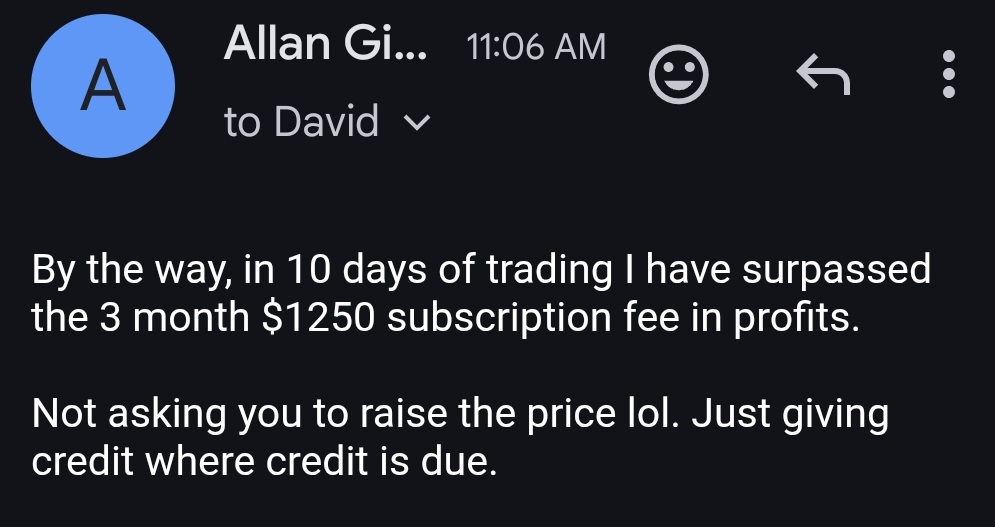
"By the way, in 10 days of trading I have surpassed the 3 month $1,250 subscription fee in profits. Not asking you to raise the price lol. Just giving credit where credit is due." — Allan G., Verified Member
For more member reviews, see our Reviews page and the 127+ five-star Trustindex reviews.
Disclaimer
These results reflect my personal trading accounts at E*TRADE (a business of Morgan Stanley). Past performance does not guarantee future results. Options trading involves significant risk of loss, including potential loss of principal. I am not a registered investment advisor. The information on this page is provided for educational purposes only and does not constitute investment advice, a recommendation to buy or sell any security, or a solicitation. The strategies described above may not be suitable for every investor. Always consult a qualified financial advisor before making investment decisions.
About the Author — David Jaffee
David Jaffee is the founder of BestStockStrategy.com and creator of the "Financed Bull" Strategy. He graduated, with honors, from Cornell University (Ivy League) and worked at Morgan Stanley, CIBC World Markets, and Petsky Prunier as an Investment Banker before becoming a full-time options trader and educator. David has taught over 3,500 students in 70+ countries, and his strategy has achieved a win rate approaching 98%. He specializes in selling option premium and buying call debit spreads for consistent profits in all market conditions.