
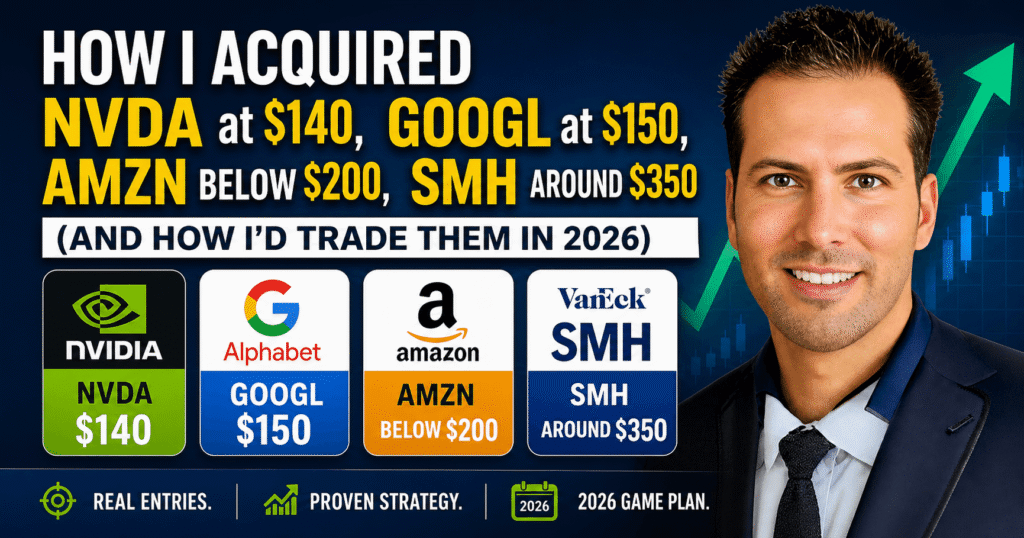
Quick Verdict: How to Buy Quality Stocks at a Discount
In my opinion, the most reliable way to acquire high-quality stocks at a discount is by selling cash-secured puts at strike prices where you'd genuinely want to own the shares. In April 2025, when President Trump's "Liberation Day" tariffs sent the market into a brief bear market, my puts on NVDA, GOOGL, AMZN, and SMH became in-the-money. I took assignment, kept the shares, and rode the recovery. Today those four positions are up between +36% and +163% — verified by real E*TRADE brokerage statements at BestStockStrategy.com/results.
Key Takeaways
- In April 2025, during the "Liberation Day" tariff crash, I took assignment on cash-secured puts on NVDA at ~$140, GOOGL at ~$150, AMZN below $200, and SMH at ~$350
- As of May 2026, those positions are up +57%, +163%, +36%, and +62% respectively — verified by real E*TRADE statements
- Assignment is not a penalty — it's a victory when you've sold puts on a stock you actually want to own
- I do NOT run the standard Wheel Strategy. After assignment on quality compounders, I keep the shares and sell covered calls far out-of-the-money (or not at all)
- For new entries at all-time highs (NVDA at ~$220, SMH at ~$568), I'm using the Financed Bull Strategy — not buying outright
- Realistic monthly target on this strategy is 2–3% — not the 10%+ "guru" promises that systematically blow up retail accounts
- This strategy works because of patience and mathematics, not predictions
The Receipts: Acquisition Prices vs. Today
Stock | Acquisition Price | Current Price (May 2026) | Pure Appreciation |
|---|---|---|---|
NVDA | ~$140 | ~$220 | +57% |
GOOGL | ~$150 | ~$394 | +163% |
AMZN | <$200 | ~$272 | +36% |
SMH |
~$350 |
~$568 |
+62% |
Note: These appreciation figures reflect pure share-price gains only. They do not include the put premiums I originally collected at entry, nor the covered call premiums I've collected on the owned shares. Total returns are meaningfully higher than the share-price column suggests.
Full verified brokerage statements documenting my multi-year track record — including the underperforming year I'm transparent about — are at BestStockStrategy.com/results.
The Industry's Most Expensive Lie: "Just Buy the Dip"
Here's the script most retail traders actually follow:
- Watch a stock rally for 12 months
- Get FOMO when it's near all-time highs
- Buy at the top
- Panic-sell during the next 20% drawdown
- Watch the stock recover without them
Now here's the script the disciplined options trader follows:
- Maintain a watchlist of large-cap quality names
- Sell cash-secured puts at strikes you'd genuinely want to own at
- Get paid premium whether the stock moves up, sideways, or down a little
- If the stock crashes hard, take assignment
- Keep the shares and ride the recovery
The first script is what scam gurus like Felix Prehn and the YouTube pump community sell to beginners — buy naked calls on whatever's trending, day-trade 0DTE lottery tickets, "let your winners run." That's the script that prints course sales for the guru while their followers blow up their accounts.
The second script is boring. It doesn't make for viral YouTube thumbnails. But it's the script that built my real verified +78% / +67% LTM returns.
In my opinion, the single most expensive lie in retail trading is "just buy the dip." Beginners think a "dip" is a 5% pullback. They don't have a plan for a real 30% bear market. They don't have a watchlist. They don't have specific strike prices they'd be happy owning at. So when an actual crisis arrives — like April 2025 — they freeze.
I didn't freeze. I had standing put orders at strike prices I wanted to own GOOGL, NVDA, AMZN, and SMH. When the tariff panic hit and prices collapsed, those orders filled. The market handed me mega-cap quality at fire-sale prices, and I let the math work.
That's what this article is about: not what I think you should do next, but what actually happened to me — verifiable via real trading statements — and how I'm playing the same names now that they're back at the top.
The Strategy in Plain English
What a Cash-Secured Put Actually Does
When you sell a cash-secured put on a stock, you're entering a contract that says: "If this stock drops below [strike price] by [expiration date], I'll buy 100 shares at the strike price." In exchange for taking on that obligation, the option buyer pays you cash up front — called the premium.
You set aside enough cash to actually buy the shares if assigned. That's the "cash-secured" part.
Three outcomes are possible:
- The stock stays above your strike at expiration. You keep the premium, no shares change hands, and you can sell another put
- The stock drops below your strike at expiration. You buy 100 shares per contract at the strike price, and you keep the premium. Your effective cost basis is the strike price minus the premium you collected
- The stock drops well below your strike before expiration. Your put may go deep in-the-money, in which case you can either take early assignment (rare) or roll the position — you can learn more about selling puts in my complete put-selling guide.
The math is simple: you get paid to set a limit order at a price below the current market. Whether the stock comes down to that limit or not, you earn cash for waiting.
Why "Strike Price = A Buy Price You'd Actually Want"
This is the single rule that separates disciplined put-sellers from gamblers.
Bad: Selling puts on speculative names you don't want to own, chasing premium yield. This is how OptionSellers.com lost $150 million in 2018 — they sold naked options on natural gas, which they had no interest in owning, into a volatility spike.
Good: Selling puts ONLY on names you'd genuinely buy at the strike price. That way assignment isn't a disaster — it's a planned outcome.
For me, that watchlist is short and disciplined: NVDA, MSFT, AAPL, AVGO, GOOGL, AMZN — plus broad-market ETFs like SPY, QQQ, and SMH. No biotech speculation. No penny stocks. No meme stocks. The complete reasoning behind this watchlist is in my guide on the best stocks for options trading.
The strikes I select are based on prices I've already decided I'd happily own the stock at — usually zones representing genuine value (post-correction levels, multi-month support, fundamental valuation anchors). The complete strategy framework is documented in my selling puts strategy guide.
Get the Complete Framework — Free Get $400+ of free options trading training and the Trader's Edge cheat sheet. Join 127+ five-star reviewers. No credit card required.
April 2025: The "Liberation Day" Crash That Set This Up
To understand why my acquisitions worked, you have to remember what April 2025 actually looked like.
On April 2, 2025, President Trump stood in the White House Rose Garden and announced what he called "Liberation Day" — a sweeping tariff package including a baseline 10% on all imports and targeted duties up to 54% on Chinese goods.
The market response was immediate and brutal:
- April 3, 2025: The S&P 500 dropped 4.84% — its worst single-day decline since June 2020. The Nasdaq fell 5.97%. The Dow lost 1,679 points
- April 4, 2025: Second consecutive day of selling. The S&P fell another ~4%, putting it down roughly 16% from peak. China announced 34% retaliatory tariffs
- April 7, 2025: The S&P 500 officially entered bear market territory (more than 20% below its highs)
- April 9, 2025: Trump paused tariffs for 90 days. Markets ripped on the news
- April 10, 2025: Profit-taking returned. S&P -3.46%, Nasdaq -4.31%
Tech got hammered hardest. AMZN fell roughly 9% in a single session. NVDA dropped ~7.8%. META fell ~9%. GOOGL declined 3.2% (less, because Google has minimal direct supply-chain exposure).
The entire semiconductor sector cratered as investors priced in disrupted global chip manufacturing.
This was what real fear looks like. Apocalyptic CNBC headlines. Reddit flooded with "I lost half my account" posts. Wall Street strategists openly debating whether we were heading into a 2008-style financial crisis.
In my opinion, this was the cleanest professional setup I'd seen since the 2020 COVID drawdown. Three reasons:
- The names crashing were quality. NVDA, GOOGL, AMZN, SMH — these aren't speculative junk. These are dominant mega-cap businesses (and ETFs) with strong moats, real earnings, and the financial firepower to navigate trade disruption. They were getting sold because of macro panic, not because anything fundamental was broken
- Volatility was extreme. When VIX spikes, options premiums fatten. The same put that paid me modest premium in February 2025 was paying multiples of that in early April 2025
- Retail was panicking. Margin calls were triggering forced selling. Hedge funds were de-risking. The marginal seller was a desperate one — and desperate sellers always create the best entries for patient buyers
My standing put orders on NVDA, GOOGL, AMZN, and SMH — orders I'd had sitting at strikes I was happy to own at for months — started filling. Some went in-the-money. I took assignment. The market handed me mega-cap quality at prices most investors only see in retrospect.
How I Acquired All Four at Prices People Now Wish They'd Had
NVDA at ~$140 — Now ~$220 (+57%)
NVIDIA had been my largest single-name exposure for most of 2024 and into early 2025. In my opinion, NVDA was — and still is — the single most important company in the AI revolution. Their data-center GPUs are the foundational layer underneath every meaningful AI deployment from OpenAI to Google to Meta.
When the Liberation Day tariffs hit, NVDA dropped roughly 7.8% in one session. Over the following two weeks, it bottomed in the low $90s before stabilizing. My puts at the $140 strike — set at a level I'd been comfortable owning months earlier — went well in-the-money.
I took assignment.
The economics at the time:
- I'd already collected put premium when I originally sold the contract
- The assignment placed NVDA shares in my account at a strike I genuinely believed represented long-term value
- My effective cost basis (strike minus premium collected) was meaningfully lower than the strike itself
As of May 11, 2026, NVDA trades at roughly $220 — up approximately +57% from my assignment price. NVIDIA reports earnings on May 20, 2026, and Goldman Sachs analysts have noted that NVDA is currently trading at roughly 10x below its three-year median price-to-earnings ratio, suggesting the stock remains reasonably valued even at these levels.
I currently hold this position. On the appreciation alone, the trade has compounded handsomely. Add in the original put premium plus the covered calls I've sold against the shares at strikes far above my cost basis, and total return is meaningfully higher than the +57% headline.
What this trade illustrates: when you're paid premium up front, take assignment on a name you actually want, and hold through the recovery, the math compounds in three directions at once.
GOOGL at ~$150 — Now ~$394 (+163%) — The Standout Win
Of the four acquisitions, GOOGL is the one I'm most pleased with — and the one that most clearly demonstrates the power of the strategy.
In April 2025, GOOGL dropped under $150 during the tariff selloff. The market was indiscriminately punishing big tech, even though Google's revenue is overwhelmingly digital and largely insulated from tariff disruption. Search, YouTube, Cloud — none of those depend on Chinese manufacturing.
I had puts sitting at $150 — a level I'd long considered fair value given Google's earnings power, balance sheet, and Cloud growth trajectory. The puts filled. I took assignment.
As of May 11, 2026, GOOGL trades around $394 — within touching distance of its all-time high of $400.80 (reached on May 8, 2026). The 52-week range is $152.20 to $402.00, which means my acquisition was effectively at the 52-week low.
What drove the recovery:
- Q1 2026 earnings showed Google Cloud growing 63% year-over-year
- Alphabet disclosed a $460 billion enterprise cloud backlog — a staggering vote of confidence from enterprise customers
- AI integration across Search, YouTube, and Workspace started compounding
- The company raised over $17 billion in bonds in May 2026 to fund continued AI capital expenditure
In my opinion, the most important lesson from the GOOGL trade is this: the market hands you world-class businesses at fire-sale prices when retail panics about macro fears that don't actually affect the underlying business. Tariffs on Chinese-manufactured goods don't change Google's search dominance. Retail panic-sellers handed me 100 shares of Google at $150, and the business kept executing.
I currently hold this position.
AMZN Below $200 — Now ~$272 (+36%)
Amazon was hit harder than Google during the April 2025 selloff because AMZN does have meaningful supply-chain exposure. Retail merchandise sourced through Chinese manufacturers, third-party seller economics, fulfillment logistics — all of those were genuinely impacted by the tariff news. AMZN dropped roughly 9% on April 3, 2025 alone.
But here's the thing: Amazon Web Services (AWS) — Amazon's most profitable segment — has essentially no direct tariff exposure. AWS is software, infrastructure, and cloud services. The market sold AMZN as if the entire business was tariff-exposed when in reality the company's most important profit driver was untouched.
My puts at below $200 filled during this period. I took assignment.
As of May 11, 2026, AMZN trades around $272 — up roughly +36% from my acquisition. Independent analyst coverage is heavily bullish: of 62 analysts covering the stock, 41 rate it Strong Buy with an average 12-month price target of $306. Morningstar's discounted-cash-flow Fair Value estimate sits at $692 — implying the stock is materially undervalued at current levels in their model.
I'm not citing those analyst opinions as predictions. I'm citing them because they illustrate that even now, with AMZN up 36% from my entry, sophisticated analysts continue to view the stock as undervalued. That's the kind of name you want to acquire on panic, not sell after a moderate recovery.
I currently hold this position.
SMH at ~$350 — Now ~$568 (+62%) — The Diversification Play
The SMH acquisition is different from the other three because SMH is an ETF — the VanEck Semiconductor ETF — rather than a single stock. Selling puts on a sector ETF gives you exposure to the full semiconductor industry without single-stock idiosyncratic risk. If one chip company stumbles, the index absorbs it. You're betting on the sector's trajectory, not any one company's execution.
In April 2025, with the broader market in bear-market territory and semiconductors getting hit hardest (concerns about Chinese supply chains and Taiwan tariff exposure), SMH bottomed in the $220–$240 range before recovering. My puts at the $350 strike — set months earlier at a level I considered reasonable for broad chip exposure — filled. I took assignment.
As of May 11, 2026, SMH trades around $568 — up roughly +62% from my acquisition. The ETF is currently at all-time highs after gaining nearly 5% on May 8, 2026 alone. Top holdings include NVDA, AVGO, TSM, AMD, and many other names that have driven the AI/chip supercycle.
What this trade illustrates: you don't have to pick the single perfect stock to participate in a sector boom. By acquiring SMH on weakness, I got proportional exposure to the entire AI/semiconductor recovery without having to make a binary call on any one company. NVDA plus my SMH allocation gave me both concentrated single-stock alpha AND diversified sector beta.
I currently hold this position.
Why I Don't Run the Full Wheel (And Neither Should You)
If you've researched put-selling online, you've encountered the "Wheel Strategy." The Wheel works like this:
- Sell cash-secured put → 2. Get assigned shares → 3. Sell covered call → 4. Shares get called away → 5. Return to step 1
The Wheel is the most-taught options strategy on YouTube. It's also, in my opinion, mathematically inferior to keeping quality shares.
Here's why: the Wheel works fine if the underlying stock chops sideways or recovers modestly. But on quality compounders during a real rally, the Wheel is a disaster. Anyone who ran a "proper" Wheel on GOOGL after assignment in April 2025 would have sold covered calls at $200, $220, $250 — and watched their shares get called away on the path to $400.
Capping your upside on a stock you actually want to compound in at 5–10% above your assignment price is a strategy that systematically transfers wealth from the patient holder to the eager call buyer. The full breakdown — with historical data showing the multi-year drag — is in my analysis of the Wheel Strategy's underperformance.
My approach is different:
- I sell puts to acquire shares (Step 1 of the Wheel — same as everyone else)
- I take assignment when puts go ITM (Step 2 — same)
- I keep the shares for long-term appreciation (Step 3 — different)
- I sell covered calls only when the stock is materially extended OR at strikes so far OTM they won't realistically get called away (Step 4 — modified)
- I never let quality compounders walk out the door for a $200 covered-call premium when the stock could double over the next two years (Step 5 — eliminated)
The Wheel is fine for stocks you genuinely don't want to own long-term — range-bound large-caps, mature businesses with capped growth, sector ETFs in sideways environments. But for AI-era compounders like NVDA and GOOGL, "wheeling out" of your position at a 5–10% gain is one of the most expensive decisions you can make.
The verified +78% / +67% LTM returns on my Results page come in significant part from not running the Wheel on quality names.
How I'm Trading NVDA, GOOGL, AMZN, and SMH in May 2026
Fast forward to May 12, 2026. NVDA is back near $220. GOOGL is at all-time highs around $394. AMZN sits at $272. SMH trades at $568.
So how am I trading these names today — when the very prices that handed me massive gains are no longer available?
On My Owned Shares: Covered Calls That Stay OTM
For shares I already own (acquired in April 2025), I'm selling covered calls far out-of-the-money — at strikes well above current price, with short-to-medium expirations.
The goal is income, not exits. I don't want these shares called away. So I structure each call sale so that:
- The strike is meaningfully higher than where I think the stock will trade by expiration
- The premium is large enough to be worth the time-decay capture
- If the stock runs hard and my call goes ITM, I roll the position up and out rather than letting the shares get called away
This is a more advanced execution layer that I cover in detail in my real-time trade alerts service — specific strike selection, when to roll, how to handle earnings volatility. The general principle: covered calls on quality compounders should be defensive income tools, not exit triggers.
On New Entries: The Financed Bull Strategy
For someone reading this article today who wants exposure to NVDA, GOOGL, AMZN, or SMH at current prices, I do NOT recommend buying shares outright. The names are extended. NVDA is in a tight range ahead of May 20 earnings. SMH is at all-time highs. AMZN and GOOGL are within striking distance of the same.
Instead, the strategy I personally use for new exposure at extended prices is the Financed Bull Strategy: buy a defined-risk call debit spread (gives you upside exposure with limited downside risk) and finance the cost of that spread by selling put premium at a strike where — once again — you'd genuinely want to own the stock.
The structure does three things at once:
- Captures upside with the call spread
- Pays for the call spread with the put premium
- Sets up another assignment opportunity if the market pulls back to the put strike
The full breakdown is in my guide on the most successful options trading strategies of 2026.
Why I'm NOT Chasing NVDA at $220 or SMH at $568
In my opinion, the worst thing a beginner could do right now is buy NVDA, AMZN, GOOGL, or SMH at current prices with no plan for a pullback, expecting the strategy described in this article to keep working.
This article works because of when I entered, not because of what I bought. The entries — at $140 NVDA, $150 GOOGL, sub-$200 AMZN, $350 SMH — were a function of patience meeting a market crisis. Those prices aren't available today.
What IS available today is the strategy: maintain a watchlist of quality names, set put orders at strikes you'd actually want to own at, and wait. The next "April 2025" — whether triggered by tariffs, geopolitics, AI deceleration, or something nobody is forecasting — will eventually arrive. Patient traders will be filled at prices most investors only see in retrospect.
See the Strategy Live Real-time options alerts from a verified Wall Street trader with +78% / +67% multi-year LTM returns. 14-day trial available.
Become a Successful & Profitable Trader
Follow My Trades with Real-Time Trade Alerts
Three Lessons This Story Teaches (That Most Retail Traders Miss)
Lesson 1: Assignment Is a Victory, Not a Penalty
Most beginner put-sellers panic when their put goes ITM. They roll defensively, close at a loss, do anything to avoid taking the shares.
This is backwards. If you sold the put at a strike you'd actually want to own the stock at — which is the only legitimate reason to sell a put in the first place — then assignment is exactly what you signed up for. It's a planned outcome, not an accident.
The traders who beat me to GOOGL at $150 in April 2025 weren't smarter than retail buyers. They simply had a plan that included "I will happily own this stock at this price" — and stuck to it when the market handed them the opportunity.
Lesson 2: Patience Beats Prediction
I didn't know April 2025 would happen. Nobody did. "Liberation Day" was an unforecastable political event that triggered an unforecastable market reaction.
What I had wasn't a prediction. It was a position. I had put orders sitting at strike prices I'd been willing to own quality stocks at for months. When the market handed me those prices, my orders filled — not because I'm a great forecaster, but because I'd already done the work of figuring out what I'd be willing to pay.
That's the actual edge. Not predicting when crashes come. Just being mechanically ready to act when they do.
Lesson 3: Position Size Matters More Than Entry
Even a perfect entry can destroy you if you're over-sized.
If I'd sold five times as many puts as I did in April 2025, I'd have been forced to liquidate during the worst of the panic — possibly at the exact bottom — because my buying power would have been crushed by margin requirements during the volatility expansion. Being right means nothing if you can't survive long enough to be paid.
Position sizing is the discipline that separates traders who get blown up in volatility expansions from traders who emerge with their best entries of the decade. The general principle: never deploy so much capital that a 20–30% temporary drawdown forces you out of your positions. My complete account-size framework is in my guide on how much money you need to sell options.
Bottom Line
This article isn't a recommendation to buy NVDA, GOOGL, AMZN, or SMH at current prices. It's a case study in how a disciplined, patient, mathematics-based strategy actually performs when the market hands you an opportunity.
In April 2025, the market handed me an opportunity in the form of a panic-driven crash. I had standing put orders at strikes I'd been willing to own quality stocks at for months. Those orders filled. I took assignment. I kept the shares. I sold covered calls that didn't get called away. And I let the math compound.
As of May 12, 2026, the four positions are up +57%, +163%, +36%, and +62% respectively, with additional return from the put premium I collected at entry and the covered calls I've sold since. All verified on real E*TRADE statements at BestStockStrategy.com/results.
The next "April 2025" is coming. It always does. The only question is whether you'll be ready with a watchlist, a plan, and pre-set strike prices — or whether you'll be the marginal seller handing your shares to someone like me.
Ready to See Verified Trades and Disciplined Risk Management? Join the 127+ five-star members already following the Financed Bull Strategy.
Take the Complete Options Trading Course
- Learn the full system so you can trade independently
- Master the complete step-by-step framework
- Understand the “why” behind every trade
- Understand the “why” behind every trade
Frequently Asked Questions
Is selling puts on tech stocks safe?
In my opinion, selling puts on large-cap, mega-cap quality tech stocks is one of the safer options strategies available — significantly safer than buying naked calls, day trading, or trading speculative small caps. The key word is "quality." Selling puts on penny stocks, biotech, or meme stocks is dangerous regardless of strategy. Selling puts on NVDA, MSFT, AAPL, GOOGL, AMZN at strikes you'd actually want to own at, with disciplined position sizing, is fundamentally different.
What happens if a stock I sell puts on crashes 50%?
You'd be assigned the shares at your strike price, which would now be well above the current market price — a paper loss, and a meaningful one. Mitigations: (1) only sell puts on quality names you're comfortable holding through a deep drawdown, (2) never over-size your position, (3) keep dry powder to average down or hedge if needed. If you'd never have bought the stock outright at the strike price, you should never have sold the put.
How much capital do I need to start selling puts on NVDA?
At NVDA's current ~$220 price, one cash-secured put contract requires you to set aside roughly $22,000 to potentially buy 100 shares. To run the strategy sustainably with diversification across multiple positions, you'd realistically want a minimum account size of $25,000–$50,000 to use NVDA specifically. My full account-size ladder is in my guide on how much money you need to sell options.
Should I run the Wheel Strategy on these stocks?
No — at least not the standard Wheel. The standard Wheel forces you to sell covered calls at strikes that will eventually get called away, capping your upside on stocks you actually want to compound in. My critique, with historical data showing long-term Wheel underperformance, is in my full Wheel Strategy analysis.
What is the "Financed Bull" Strategy?
The Financed Bull is the strategy of buying a defined-risk call debit spread (which captures upside with limited risk) and financing the cost by selling put premium at a strike where you'd happily own the stock. It gives you upside exposure plus a potential acquisition opportunity, paid for by the put premium. The full guide is at Most Successful Options Trading Strategies.
What delta should I sell puts at?
In general, conservative put-sellers operate in lower-delta zones with higher probability of profit, while more aggressive sellers move closer to the money for more premium at lower probability. The specific delta I select depends on the stock, the volatility environment, and the account context — which is what the alerts service is for. The detailed framework is covered in my best delta to sell puts guide.
Why didn't you just buy the stocks outright in April 2025?
I did add to some positions. But the put-selling approach has a critical advantage over outright buying: I get paid to wait at my desired price. If GOOGL had recovered without ever hitting my $150 strike, I would have kept the premium and either re-sold the put at a higher strike or moved on. With outright buying, you only profit if the stock recovers from your entry price.
Can I do this in an IRA?
Yes, but with restrictions. You cannot sell naked puts in an IRA — they must be fully cash-secured. That's fine for the strategy described here; cash-secured puts work well in Roth IRAs and Traditional IRAs alike, with the added benefit that gains compound tax-advantaged.
What if you'd been assigned and the stocks kept dropping?
It happens. In April 2025, GOOGL dipped briefly below $150 before recovering. NVDA dropped into the $90s after my assignment. I held paper losses on some positions for weeks. The mitigation isn't avoiding this risk — it's: (1) only sell puts on names you're comfortable holding through 30%+ drawdowns, (2) never deploy so much capital that a temporary mark-to-market loss forces you out, and (3) maintain hedges at the portfolio level so unrealized losses don't compound.
How do I know your returns are real?
Every claim in this article is backed by real E*TRADE brokerage statements posted publicly at BestStockStrategy.com/results. That page includes monthly statement screenshots, video walkthroughs of the accounts, multi-year history (including the underperforming year I'm transparent about), and 127+ verified five-star Trustindex reviews. If you have any doubt about authenticity, the proof is on the Results page.
It's also worthwhile to read The Best Selling Puts Strategy for Beginners
Disclaimer
This article reflects my personal opinion and analysis only. I am not a registered investment advisor. Nothing in this article constitutes investment advice, a recommendation to buy or sell any security, or a solicitation. I currently hold long positions in NVDA, GOOGL, AMZN, and SMH. Past performance does not guarantee future results. Options trading involves significant risk of loss, including potential loss of principal. The strategies described may not be suitable for every investor. Always consult a qualified financial advisor before making investment decisions.