
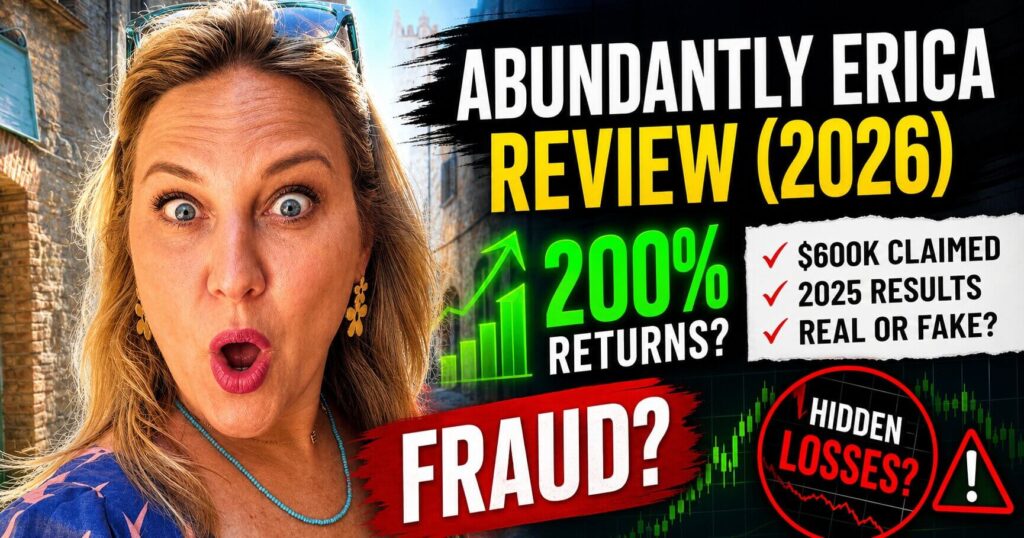
Abundantly Erica Review: 200% Returns or Hidden Losses? (2026)
Last Updated on July 16, 2026 by David Jaffee
Quick Verdict: Tons of Red Flags and Return Claims I Don’t Believe
Is Abundantly Erica legit? In my opinion, no — and the 2026 version of her story is worse than the 2025 version. Abundantly Erica (real name Erica Chadwick) now publicly claims she made “over 200% gains” and “$600k+ trading stock options in 2025,” posting a brokerage screenshot showing a 217.40% “cumulative rate of return.”
I do not find those numbers credible. In her own October 2025 account-update video, the public account she shows was up roughly 31% — not 200%. Then a routine 5% market pullback in November hit her highly leveraged, meme-stock LEAPS portfolio so hard that, based on my own position-by-position analysis, I believe she was likely down ~$100,000 (around 28%) and may have faced a margin call. Weeks later she advertised a 217% year. In my opinion, those two pictures cannot be reconciled, and the return claims she is using to sell a $6,000 “Millionaire Mentorship” appear false or misleading.
She also admits to trading “8 accounts,” with most kept private — which, in my opinion, is exactly how someone showcases a single winner while hiding the losers. If you want a track record you can actually verify, see my real, third-party-documented E*TRADE results instead.
Get the Complete Framework — Free
Get $400+ of free options trading training and the Trader’s Edge cheat sheet. Join 127+ five-star reviews. No credit card required.
Key Takeaways
- Abundantly Erica’s real name is Erica Chadwick; she operates a YouTube and X account (womenoptionswin) and a Kajabi-hosted course.
- In January 2026 she publicly claimed “over 200% gains” and “$600k+” in 2025, posting a screenshot of a 217.40% cumulative rate of return.
- In her own October 2025 update, the public account she displays was up only about 31% — a figure that cannot be squared with a 217% year.
- Based on my position-by-position breakdown of her October positions, a standard 5% market pullback in November 2025 likely caused an estimated ~$100,000 (~28%) drawdown and a possible margin call.
- Her portfolio was loaded with long-dated LEAPS and shares on volatile names like ASTS and IONQ — high-leverage speculation, not hedged, risk-defined investing.
- She has publicly stated she trades “8 accounts” and makes income in her “not public accounts” — in my opinion, a setup that enables showcasing one winner while concealing the rest.
- She has never published a third-party-audited or verified brokerage statement; a “rate of return” widget is not a verified track record.
- Her marketed “retired” status is contradicted by Illinois records showing she is the active President of ETC. Creative, Inc., a talent agency.
- A former student says her $6,000 “Millionaire Mentorship” was repackaged free content, that a $5,000 refund check bounced, and that the refund was eventually paid through multiple Venmo accounts over several days.
- She has threatened critics (including BestStockStrategy) with copyright lawsuits, claiming she “always won” — claims for which no court record could be located.
- In my opinion, the safer path is a verified, hedged strategy — see my verified results and my guide to selling option premium.
Abundantly Erica: 2026 Status Update
When I first reviewed Abundantly Erica, the open question was whether she had quietly quit after going silent following a brutal November 2025 drawdown. That question has been answered — and not in her favor.
She did not quit. She doubled down. Here is where things stand in 2026:
- On January 3, 2026, she posted to X: “Insane 1 year result. Over 200% gains. SPY returned 18% I did 11 times better than SPY,” attaching a brokerage screenshot showing a 217.40% cumulative rate of return from Jan 3, 2025 to Jan 2, 2026.
- Her X profile is now pinned with: “Click below to watch how I made $600k+ trading stock options in 2025.”
- She continues to market a $6,000 “Millionaire Mentorship” and a Kajabi course, and to publish single-account income screenshots.
- She has openly referenced trading “8 accounts,” including income made in accounts she does not show publicly.
- Her channel womenoptionswin remains active, with roughly 9,400+ followers on X.
In other words: after a documented near-wipeout on a 5% dip, the public claims got bigger, not smaller. That escalation — louder numbers right after the period where I believe she was deep in the red — is the heart of this updated review.
Watch the Full Investigation
9 Reasons Why Abundantly Erica Is a Major Red Flag (2026)
1) The 200% / $600K Return Claim Is, In My Opinion, Not Credible
This is the headline problem. In January 2026, Erica publicly claimed “over 200% gains” and “$600k+ trading stock options in 2025,” posting a brokerage “rate of return” screenshot reading 217.40% for the year.
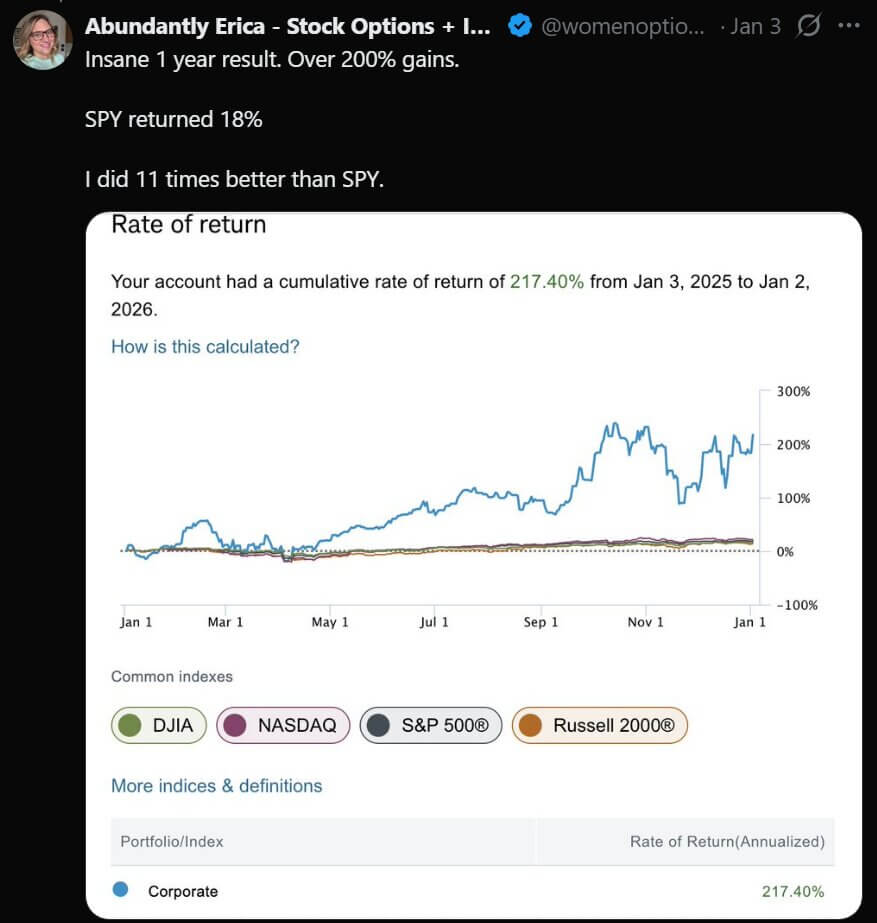
Here is why I don’t believe it. In her own October 20, 2025 account-update video, the public account she walks through was up roughly 31% on a value-versus-contributions basis — her number, not mine. A 31% account in October does not become a 217% year in January, especially after the month that came in between. Between her October update and the November lows, the S&P 500 fell about 5% — and as I show position by position in the video above, that ordinary pullback likely cratered her leveraged book by an estimated ~$100,000 (~28%).
So the timeline is: ~31% in October (her figure) → an estimated ~28% drawdown in November (my analysis of her positions) → a claimed 217% for the full year (her figure). In my opinion, those numbers cannot be reconciled. I believe the public return claims she uses to sell her mentorship are false or misleading.
It is also worth understanding what a “rate of return” widget actually is. It is a time-weighted percentage generated by a brokerage tool — not a verified, third-party-audited statement of realized dollar profit, and not proof of skill. Time-weighted return figures can diverge sharply from what a trader actually keeps, particularly when deposits, withdrawals, and multiple accounts are in play (more on the accounts below). A screenshot of a percentage is not a track record.
2) The “8 Accounts” Problem: Showcase One, Hide the Rest
Erica has publicly stated she trades “like 8 accounts.” In her own words on X (June 24, 2025): “the is the income from 1 of my 8 accounts. I’ve made 20k+ in the other accounts I manage.” In the comments of her October video she added that a given figure was “not a part of the 45K I make in my not public accounts.”

This matters enormously. When you run eight accounts and only ever publish one, you can always select whichever account happens to be green this month and present it as your “result,” while the underperforming or blown-up accounts stay invisible. In my opinion, that is precisely the mechanism a promoter uses to manufacture a track record. A single hand-picked account, shown out of eight, tells a prospective student nothing about whether the strategy actually works — and everything about how the marketing is constructed.
3) A Routine 5% Dip Likely Caused a ~28% Drawdown – Position by Position
The reason I don’t believe the 2025 return claim is the same reason I believe her strategy is dangerous: it is built on leverage that turns an ordinary market wobble into a catastrophe.
In her October 20, 2025 update, Erica displayed an account worth roughly $355,000, with a year-to-date profit of about $99,000. Then the S&P 500 fell about 5% into the November 21 lows. Here is what that did to the leveraged positions she showed, on a pro-forma basis.
The ASTS Trap
She held 700 shares of ASTS, worth about $59,700 in her video. At the November 21 low (~$49.31), those shares were worth roughly $35,000 — an estimated ~$25,000 hit to her net liquidation value, before factoring in her ASTS LEAPS, which decay rapidly as the stock craters.
The IONQ Margin Spiral
She held 700 shares of IONQ near a ~$60 cost basis, plus assigned shares (100 at $60, and 300 via a 66/55 put credit spread) and a stack of long-dated IONQ LEAPS (the $90, $100, and $120 strikes into 2027). As IONQ fell toward ~$38–$40, the shares alone shed roughly $14,000 and the LEAPS were down an estimated 40–55%. Combined IONQ damage: an estimated ~$20,000+, with her IONQ maintenance margin alone climbing toward ~$183,000.
Amazon and Palantir
She held 400 shares of Amazon (with 220-strike puts that went in-the-money on November 21, forcing assignment or a costly roll) and 330 shares of Palantir (which fell toward ~$150). Together these added an estimated ~$20,000 more in net-liquidation erosion.
The Margin-Call Math
Add it up and her approximate net liquidation value fell from ~$355,000 toward ~$265,000, while her maintenance-margin requirement climbed toward ~$245,000 — leaving only about $20,000 of cushion. And that is before counting the buying-power drag of every LEAP and any new positions she may have added as the market dropped. (To be fair, a few holdings like Walmart held up — but they were nowhere near enough to offset the carnage in the speculative names.) For a trader using Regulation T margin, that is the zone where a forced liquidation becomes a real possibility. In my opinion, she was extremely lucky to avoid a margin call — if she avoided one at all.
The Bottom Line
A 5% index pullback plausibly erased an estimated ~$90,000–$100,000 (~28%) — nearly her entire year-to-date profit — in a single account. In my opinion, that is not investing; it is gambling with a ticking time bomb, and it is the mathematical reason a “217% year” claim posted weeks later does not hold together. (For the full position-by-position walkthrough, watch the investigation above.)
4) No Verified or Third-Party-Audited Statements — Ever
For all the screenshots, Erica has never done the one thing that would settle the question: publish verified, third-party-documented brokerage statements across a full track record, including the losing months.
A “rate of return” graphic, a cropped income screenshot, or a single-account overview is not verification. None of it is audited, none of it shows the other seven accounts, and none of it survives the obvious follow-up question — show the November statement. In my opinion, the absence of a complete, verifiable record after years of bold public numbers is itself the answer. Compare that to a verified results page built on real, multi-year E*TRADE statements that include the flat years, not just the good ones.
The big problem for Erica Chadwick is that she consistently makes income claims which, in my opinion, are false or misleading. In the event of litigation, her trading statements will be subpoenaed and she will have to validate her claims (shown below). Personally, I believe that she’s not a profitable trader.
Erica Chadwick also posts on X.com, claiming a $450k profit.

She also claims to make “well over 50K per month trading.”

We question the mathematical feasibility of making “well over 50K per month trading” if a 5% correction could have forced her into a margin call — or potentially triggered a margin maintenance requirement and forced liquidation.
5) The “Retired” Myth vs. Illinois Public Records
A central pillar of the brand is that Erica is “retired” and simply trades for a living. Illinois business records tell a different story.


Public records for ETC. CREATIVE, INC. (File #64637827) show the corporation is Active, with Erica Chadwick listed as Principal/agent. By her own account she also describes a current career “in image licensing” and “video and photography production on advertising.” Those are not the activities of someone who retired from work to day-trade. In my opinion, the “retired trader living off her gains” narrative is marketing, not reality — and notably, the 217.40% screenshot she posted is from an account labeled “Corporate,” consistent with money flowing through a business rather than a retired individual trading her own savings.
6) Inside the $6,000 “Millionaire Mentorship”: Repackaged Content and a 4-Hour Work Month
A former student who paid $6,000 for Erica’s “Millionaire Mentorship” contacted me directly to share their documented experience. According to that student:
- The material was largely a “repackaging” of basic, free YouTube content, padded into a paid program, with spelling errors in slides and contradictory trading directions.
- Erica was observed breaking her own stated rules — publicly cautioning against speculative names while posting speculative trades to beginners.
- In a YouTube video, she reportedly bragged about taking long naps and spending only “4 to 5 hours per month” managing the mentorship — for a community charging thousands of dollars.
As one concrete example, the former student described how a basic in-the-money LEAPS covered call was rebranded as the proprietary-sounding “Rich Woman’s Covered Call,” and how a single covered-call concept was split across multiple videos and sold as different “strategies” that differed only by which delta strike was selected. Despite marketing about a “secret sauce” that supposedly made her approach more profitable, the student — profitable on his own for years — found nothing beyond what is freely available. He also observed her posting speculative trades such as SOFI and PLTR to a community of mostly brand-new traders, directly against the rules she preaches publicly.

In my opinion, charging $6,000 for recycled free content and a few hours a month of attention is the actual business model — and it is a far more reliable income source than the trading.
See the Strategy Live
Real-time options alerts from a verified Wall Street trader with +78% multi-year returns. 14-day trial available.
7) The Bounced $5,000 Check and the Multi-Venmo Refund
When that same student pushed back, Erica agreed to a $5,000 refund and mailed a business check. According to the student, the check bounced. The refund was eventually paid — but through a bizarre workaround: multiple Venmo transactions, sent from different accounts, over several days.
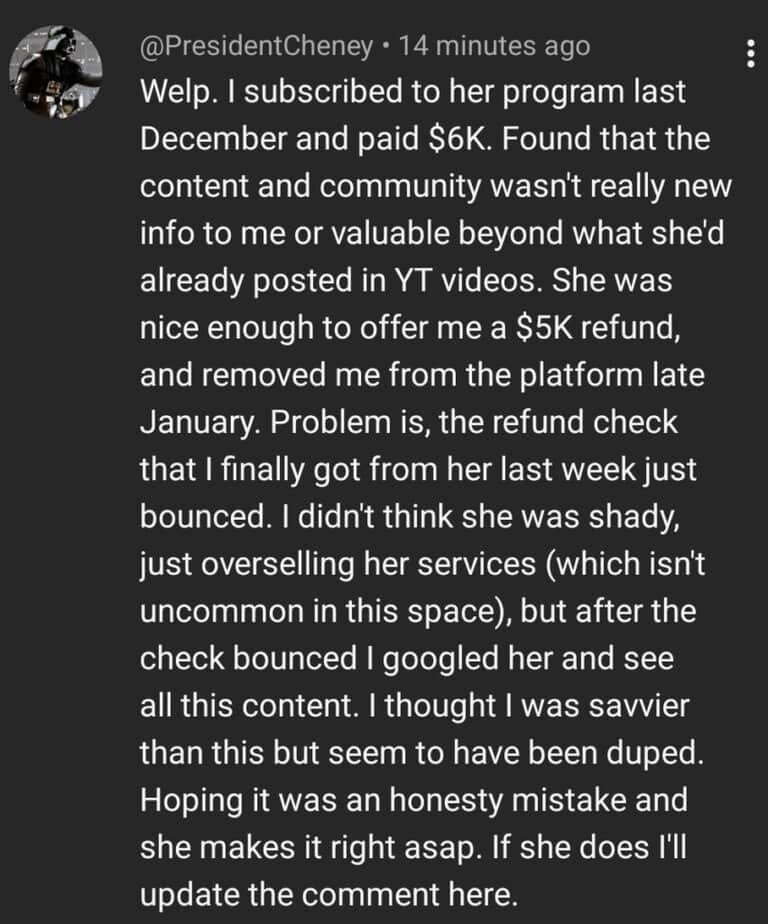
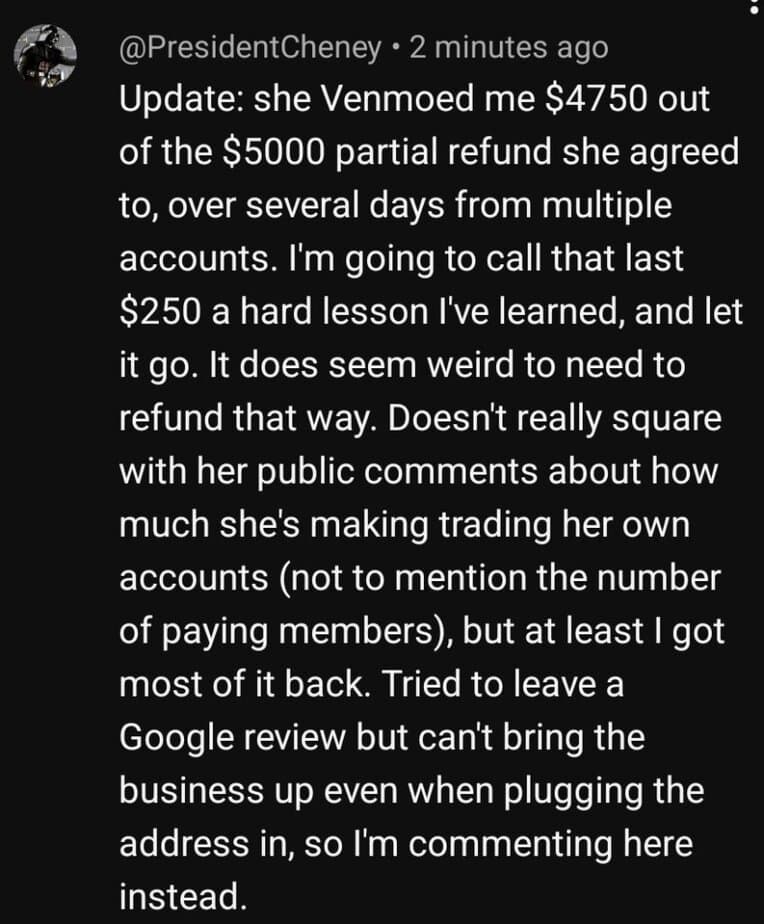
The details make it worse. According to the student, the refund ultimately came up short — about $4,750 instead of $5,000 — with the final $250 arriving from a separate Venmo account. When he asked about the piecemeal payments, she reportedly replied that “it’s impossible to get them to work out issues like this, and I don’t have time for it” — a striking line from someone who, weeks earlier, was bragging on video about long naps and a four-hour work month.
To her credit, she eventually made the student whole. But ask the obvious question: if someone is genuinely earning “well over $50k per month” and just posted a 217% year, why would a single $5,000 business check bounce, and why would a refund have to be scraped together from several Venmo accounts? In my opinion, this points directly at the liquidity reality behind the screenshots — and it lines up exactly with a portfolio that I believe took a heavy November hit.
8) Copyright-Troll Threats Against Critics
Rather than answer questions about her numbers, Erica has tried to intimidate critics — including my BestStockStrategy channel — with threats of “copyright infringement” lawsuits, claiming a former career in image licensing and insisting she “always won” and would collect “$30k–$150k per image.”

When I asked her for a single case number so the docket could be reviewed, none was provided; she pivoted to claiming the cases were sealed by NDAs (which, due to litigation privilege, would not prevent disclosing a case number). A search of Cook County, Illinois court records turned up no evidence of these constant litigation wins. In my opinion, the legal threats are bluster designed to scrub criticism — and using copyright as a weapon to silence honest review is itself a red flag. For the record: in financial reviews, fair use permits sampling content for criticism and education.
9) High-Leverage Meme-Stock LEAPS Are Gambling, Not a “Premium” Strategy
Erica markets herself as a disciplined “options premium seller.” Her actual book — long-dated LEAPS, assigned shares, and short puts concentrated in volatile names like ASTS, IONQ, and PLTR — is the opposite of conservative premium selling. Holding shares against short calls ties up enormous buying power with capped upside and uncapped downside; stacking speculative LEAPS on top means a 5% index move can become a 25%+ portfolio move.
In my opinion, this is the single most important point for a beginner to understand: the strategy is not engineered to survive a normal correction. It is engineered to look spectacular in a bull market and to quietly implode the moment volatility returns — which is exactly the pattern the November 2025 drawdown exposed.
Abundantly Erica Net Worth and Real Name
What is Abundantly Erica’s real name and net worth?
Abundantly Erica’s real name is Erica Chadwick. I would estimate her net worth at roughly $700,000, and — importantly — I believe the vast majority of it comes from her business, course, and social-media income, not from trading profits.
Where does the money actually come from?
In my opinion, the durable income here is the $6,000 mentorship, the Kajabi course, and the audience she monetizes — supported by ETC. Creative, Inc. and her image/production work — not a verified trading edge. Her own behavior supports this: a $5,000 check that bounced and a refund paid in Venmo fragments are not the cash-flow signature of someone compounding a real seven-figure trading account.
Why this matters for prospective students
When the headline returns are unverified, drawn from one of eight accounts, and contradicted by the trader’s own earlier numbers, the “net worth from trading” story collapses — and what remains is a net worth built on selling the dream of trading to beginners. That is the distinction every prospective student should weigh before paying a cent.
A Better Way: The “Financed Bull” Strategy
You do not need eight accounts, meme-stock LEAPS, or a $6,000 mentorship to build wealth. You need a strategy that is mathematically built to survive a correction — and a track record you can actually verify.
At BestStockStrategy, the method is selling option premium with debit-spread hedging (the “Financed Bull”): buying a call debit spread to capture upside with defined, capped risk, and financing it by selling puts only on high-quality, large-cap leaders at prices where you’d genuinely want to own the shares. The goal is a realistic few percent a month with risk you control — not a 217% screenshot you can’t.
| Factor | Abundantly Erica | The “Financed Bull” (BestStockStrategy) |
|---|---|---|
| Core method | High-leverage long-dated LEAPS + shares + short puts on volatile names | Selling option premium with debit-spread hedging (Financed Bull) |
| Underlyings | Speculative / “meme” stocks (ASTS, IONQ, PLTR) | Large-cap market leaders (AMZN, GOOGL, etc.) |
| Behavior in a 5% dip | Estimated ~28% drawdown / possible margin call | Defined, hedged risk — built to survive corrections |
| Track record | Unverified screenshots; ~8 accounts, only 1 shown | Verified +78% / +67% on real E*TRADE statements |
| Transparency | No third-party-audited statements; losing months hidden | Full multi-year brokerage statements, including flat years |
| Cost to learn | $6,000 “Millionaire Mentorship” | 14-day trial ($279); real-time alerts |
| Income framing | “$50k+/month,” 200% / $600K (unverified) | Realistic few percent a month, documented |
Ready to See Verified Trades and Disciplined Risk Management?
Join the 127+ five-star members already following the Financed Bull Strategy.
Conclusion: My Abundantly Erica Review
In my opinion, Abundantly Erica is not a legitimate trading educator, and her 2025 return claims are not credible. I believe a routine 5% pullback likely put her deep in the red in November 2025, and that the subsequent “200% / $600k / 217%” marketing cannot be reconciled with her own earlier numbers, with the documented drawdown, or with the fact that she shows one cherry-picked account out of eight while hiding the rest.
Strip away the screenshots and what remains is a familiar structure: unverified returns, a high-leverage strategy that can’t survive a correction, a “retired” narrative contradicted by public records, a $6,000 mentorship built on repackaged content, a bounced refund check, and legal threats aimed at silencing critics. I would avoid the mentorship entirely.
If you are evaluating Abundantly Erica, demand the one thing that would end the debate: complete, third-party-verifiable statements across all accounts, including the losing months. Until that exists, treat the numbers as marketing. If you’d like to see what a verified record actually looks like, start with my verified results and my approach to options trading strategies that prioritize survival first.
For comparison, you can read how similar leverage and earnings-claim problems played out with Tori Trades and her ~$250k drawdown, how Warrior Trading’s earnings claims drew a $3M FTC settlement, and how Options with Ryan presented account values.
Erica is part of a wider pattern of YouTube traders with no verified results — another example is Peachy Investor, which I break down here.
Alternatives to Abundantly Erica (2026)
Erica teaches premium selling — the same broad category I trade. So the alternative here isn’t a different strategy; it’s the same strategy done with verification and hedging.
1. Premium selling with verified results. As documented in this review, in my opinion Erica’s advertised returns don’t survive scrutiny. Mine are published and verified: +78% (~$700K) and +67% (~$2M) over the trailing twelve months — see the results page. The strategy is selling option premium with debit-spread hedging (Financed Bull).
2. Premium selling with hedging. Unhedged premium selling works until it suddenly, catastrophically doesn’t. Hedging with debit spreads is the difference between an income strategy and a time bomb — my selling option premium guide explains how, free.
3. Start free. My free training covers the foundation before you spend a dollar with anyone.
Looking for a Legitimate Options Trading Education?
If you’re researching trading educators because you’ve been burned (or want to avoid being burned), here’s what actually works.
I’m a former Wall Street investment banker — interned at Morgan Stanley, then worked at CIBC World Markets and Petsky Prunier. I generate verified +78% and +67% returns on real E*TRADE accounts, fully documented at my verified results page.
The strategy that actually works isn’t day trading penny stocks, buying expensive courses from people without verified records, or following unverified trading “gurus.” It’s selling option premium with debit-spread hedging for consistent monthly income on high-quality stocks.
Read my guide to Selling Options Premium for Consistent Income — or join the 127+ five-star reviewers who follow my real-time trade alerts.
Consumer Resources & Protection
If you feel you’ve been misled by Abundantly Erica, the “Millionaire Mentorship,” or any high-priced trading course, you have the right to report deceptive marketing or unhonored refunds. Consider filing complaints with:
- Federal Trade Commission (FTC): Report Fraud & Deceptive Advertising
- Securities and Exchange Commission (SEC): Submit an Investment Fraud Tip
- Illinois Attorney General: File a Consumer Complaint (Illinois)
- Find Your State Attorney General: NAAG Directory
- Better Business Bureau (BBB): File a Complaint
- Consumer Financial Protection Bureau (CFPB): Submit a Complaint
- FBI Internet Crime Complaint Center (IC3): Report Online Financial Misconduct
Note: the FTC’s case against Warrior Trading established that showing a promoter’s own trading results to imply customers will achieve similar success can itself be “misleading and deceptive” — a standard worth keeping in mind when evaluating any guru’s screenshots.
Get the Complete Framework — Free
Get $400+ of free options trading training and the Trader’s Edge cheat sheet. Join 127+ five-star reviewers. No credit card required.
Frequently Asked Questions (FAQs): Abundantly Erica
Is Abundantly Erica legit?
In my opinion, no. Her return claims are unverified and, I believe, contradicted by her own earlier numbers and a documented November 2025 drawdown. She shows one account out of a stated eight and has never published complete, third-party-verifiable statements. I would not pay for her mentorship.
What is Abundantly Erica’s real name?
Her real name is Erica Chadwick. She operates the womenoptionswin channel on YouTube and X and is the active President of ETC. Creative, Inc., an Illinois talent agency.
What is Abundantly Erica’s net worth?
I estimate her net worth at roughly $700,000, and in my opinion the large majority comes from her course, mentorship, and business income — not from a verified trading edge.
Did Abundantly Erica really make 200% (or $600K) in 2025?
She publicly claimed “over 200% gains,” “$600k+,” and a 217.40% rate of return. In my opinion those claims are not credible: her own October 2025 update showed roughly 31% on the account she displays, and a 5% market pullback in November likely caused an estimated ~28% drawdown. A screenshot of a rate-of-return percentage is not a verified statement, especially when seven of her eight accounts are never shown.
Why does it matter that she trades “8 accounts”?
Because publishing one account out of eight lets a promoter showcase a winner while hiding the losers. By her own words she makes income in “not public accounts.” In my opinion, a single hand-picked account is marketing, not proof that the strategy works.
Is Abundantly Erica really retired?
Illinois public records show she is the active President of ETC. Creative, Inc., and she has described a current career in image licensing and video/photography production. In my opinion, the “retired trader” narrative is marketing rather than reality.
How much does Abundantly Erica’s Millionaire Mentorship cost?
A former student reported paying $6,000. According to that student, the material was largely repackaged free content, and a $5,000 refund check bounced before being paid via multiple Venmo transactions.
What stocks and strategy does Abundantly Erica trade?
Her displayed positions have included high-leverage, long-dated LEAPS and shares on volatile names such as ASTS, IONQ, and PLTR. In my opinion this is speculative gambling, not the conservative “premium selling” she markets — and it is why a small market dip can cause an outsized loss.
Has Abundantly Erica been sued or investigated?
I’m not aware of a regulatory action against her. She has threatened critics with copyright lawsuits and claimed she “always won,” but no supporting court records could be located in Cook County, Illinois. Those claims should be treated as unverified.
What is a better alternative to Abundantly Erica?
In my opinion, a verified, hedged approach beats unverified screenshots. I trade and teach selling option premium with debit-spread hedging (the “Financed Bull”) on high-quality large-caps, with results documented on my verified results page. Start with my free training or my guide to selling option premium.
This article reflects my personal opinions and analysis. It is not financial advice, and I am not a registered investment advisor. References to Abundantly Erica / Erica Chadwick reflect my opinions based on publicly available information and documented accounts. Past performance does not guarantee future results.
See also my review of Investing With Brandon (Brandon Arnett).
About the Author David Jaffee
David Jaffee is the founder of BestStockStrategy.com and creator of the "Financed Bull" Strategy. He graduated from an Ivy League university and worked as an investment banker on Wall Street before becoming a full-time options trader and educator. David has taught 3,500+ students in 70+ countries and publishes his actual E*TRADE brokerage statements so you can see his real trades, not hypothetical ones. He specializes in selling options for premium income and buying call spreads for long-term wealth building. See My Brokerage Statements | Member Reviews | Trading Course and Trade Alerts | Watch on YouTube | Personal Website
Related Posts
Investing With Brandon Review: Is Brandon Arnett a Liar? (2026)
Karl Domm’s Earnings Edge Strategy: What the Numbers Actually Mean (2026 Analysis)
Is Peachy Investor Legit? My Brittney Pernell Review (2026)
Warrior Trading Review: Ross Cameron Net Worth, the $3M FTC Settlement and Much More (2026 Update)
Stocks with Josh Review: Legit Trader or Technical Analysis Trap?