

Quick Verdict: Is Warrior Trading, and Ross Cameron, Legit and Worth Paying For?
I would approach Warrior Trading cautiously because of its 2022 FTC settlement and the historical student-outcome evidence discussed below.
In April 2022, Warrior Trading and Ross Cameron agreed to a $3 million settlement resolving FTC allegations about misleading earnings claims. The stipulated order states that the defendants did not admit or deny the allegations.
The central purchasing question is whether the evidence supports the results a prospective student expects—not simply whether the educator can trade profitably.
This review examines the FTC case, historical customer reports, marketing claims, and relevant court records. Historical complaints do not establish the experience of every customer or the terms of today’s offering.
If you are researching day trading courses, you have likely seen Ross Cameron of Warrior Trading. His YouTube advertisements frequently showcase significant trading gains.
However, a deep dive into public records reveals a history that includes a federal regulatory settlement, a lawsuit against a critic that was dismissed under California's anti-SLAPP law, and a former co-owner with a criminal conviction.
Key Takeaways
- In April 2022, Warrior Trading, Warrior Operating and Ross Cameron agreed to a $3 million settlement resolving FTC allegations about misleading earnings claims, without admitting or denying them.
- The FTC's complaint alleged that "the vast majority of customer accounts actually lost money," based on customers' brokerage records.
- Warrior-branded marketing claimed its community was "over 80% profitable." The FTC's complaint alleges the opposite.
- 22 complaint records from the FTC's FOIA production (2018–2021) describe subscription-pricing disputes, refunds tied to finishing course modules, and a removed negative review. These are allegations, not findings.
- SureTrader, a broker many Warrior students used, published a 2017 post saying nearly all clients referred by Warrior Trading lost money.
- New York's Education Department certified in 2017 that it found no architecture license for Ross Cameron, despite "From NYC Architect to Day Trader" marketing.
- Ross Cameron sued critic Emmett Moore in 2017; the court granted Moore's anti-SLAPP motion in 2018.
- Former co-owner Jeffrey Fortis (about 30% of the shares) pleaded guilty to two misdemeanor counts in 2013 after the felony counts were dismissed.
- In my opinion, Ross Cameron's net worth (upwards of $35 million, by my estimate) comes mainly from courses and subscriptions, not trading.
- For most people, selling option premium with debit-spread hedging (Financed Bull) is a better fit than day trading small caps.
Want the Framework I Trade Instead?
Get $400+ of free options training and the Trader's Edge cheat sheet. No credit card required.
The $3 Million FTC Settlement (2022)
In April 2022, the Federal Trade Commission (FTC) took action against Warrior Trading, Warrior Operating Inc., and Ross Cameron.
The FTC's complaint alleged that the defendants engaged in deceptive practices regarding the potential for consumers to earn money. The Commission specifically challenged the company's claims that consumers could earn a full-time income with minimal capital.
The Outcome:
Without admitting or denying the allegations, Warrior Trading and Ross Cameron agreed to a Stipulated Order for Permanent Injunction and a $3,000,000 monetary judgment to provide refunds to consumers.
+ Read the Full Stipulated Order for Permanent Injunction, Monetary Judgement and Other Relief
+ Read the 22 complaint records from the FTC's FOIA production (2018–2021), compiled by BestStockStrategy
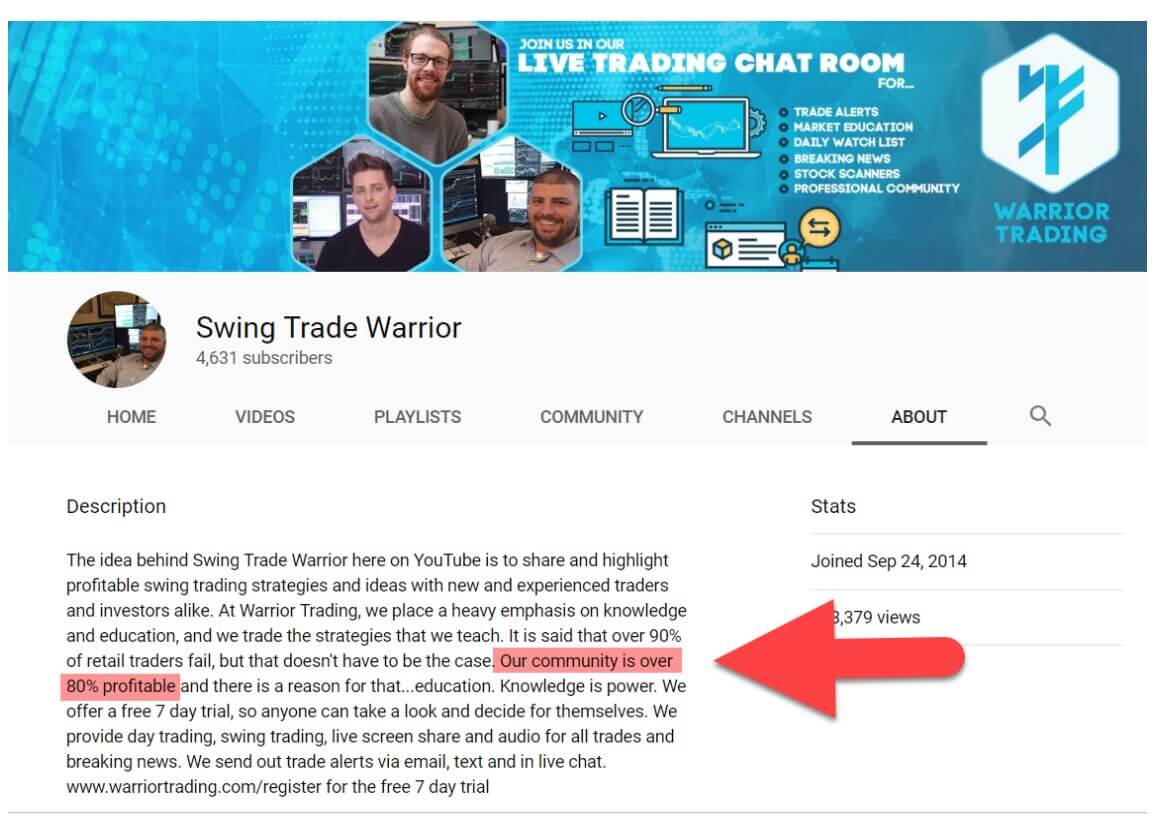
Warrior Trading's own marketing made the opposite claim. The "Swing Trade Warrior" YouTube channel — carrying Warrior Trading branding and linking to warriortrading.com/register — stated in its About section that while over 90% of retail traders are said to fail, their community is over 80% profitable, and credited education for the difference.
The FTC's complaint alleged the opposite: based on its review of customer brokerage records, the FTC alleged that the vast majority of customer accounts lost money. Warrior Trading and Ross Cameron settled without admitting or denying the allegations.
Warrior Trading Complaints: What 22 FTC Records Contain
The linked compilation presents 22 complaint records identified as FTC FOIA production 2021-00436, dated February 22, 2018 through January 10, 2021. They contain consumer allegations, not adjudicated findings.
These are not necessarily 22 separate customers or incidents. Several records have overlapping narratives, and one describes a person using Ross Cameron’s picture on Facebook Messenger. That report does not establish that Warrior Trading received the money.
Three examples are particularly relevant to prospective buyers:
Subscription-pricing dispute — January 7, 2019
In complaint #4, an Illinois consumer reported an advertised price of $497, a confirmation showing four payments of $147—$588—and total charges of $785 after an additional $197 charge. The consumer said the recurring subscription terms had not been disclosed before purchase. Related Illinois records discuss similar events and should not automatically be counted as separate customers.
Source: Complaint #4, PDF page 15; related records #5–#8.
Refund-completion requirements — April 27, 2018
In complaint #3, a Texas consumer reported paying $3,009.30 for education and $997 for community access. The consumer said a refund required completing four modules, which they estimated involved approximately 20 hours of videos and 80 essay questions. They reported stopping the coursework and unsuccessfully disputing the purchase through Discover.
The two amounts in the narrative total $4,006.30; the record’s separate “amount paid” field lists $4,006.00.
Source: Complaint #3, PDF pages 13–14.
Negative-review and account-closure allegation — March 28, 2019
In complaint #12, a California consumer alleged that their account was closed and a negative Trustpilot review was removed after the company cited restrictions on derogatory comments.
The record contains the classifications “CRFA” and “Consumer Review Fairness Act.” Those classifications do not establish that the FTC determined a violation occurred.
Source: Complaint #12, PDF page 24.
These historical reports raise questions about pricing disclosures, refund requirements, and treatment of negative reviews. They do not establish current policies, a complaint rate, or that the FTC’s later lawsuit adopted every allegation in this production.
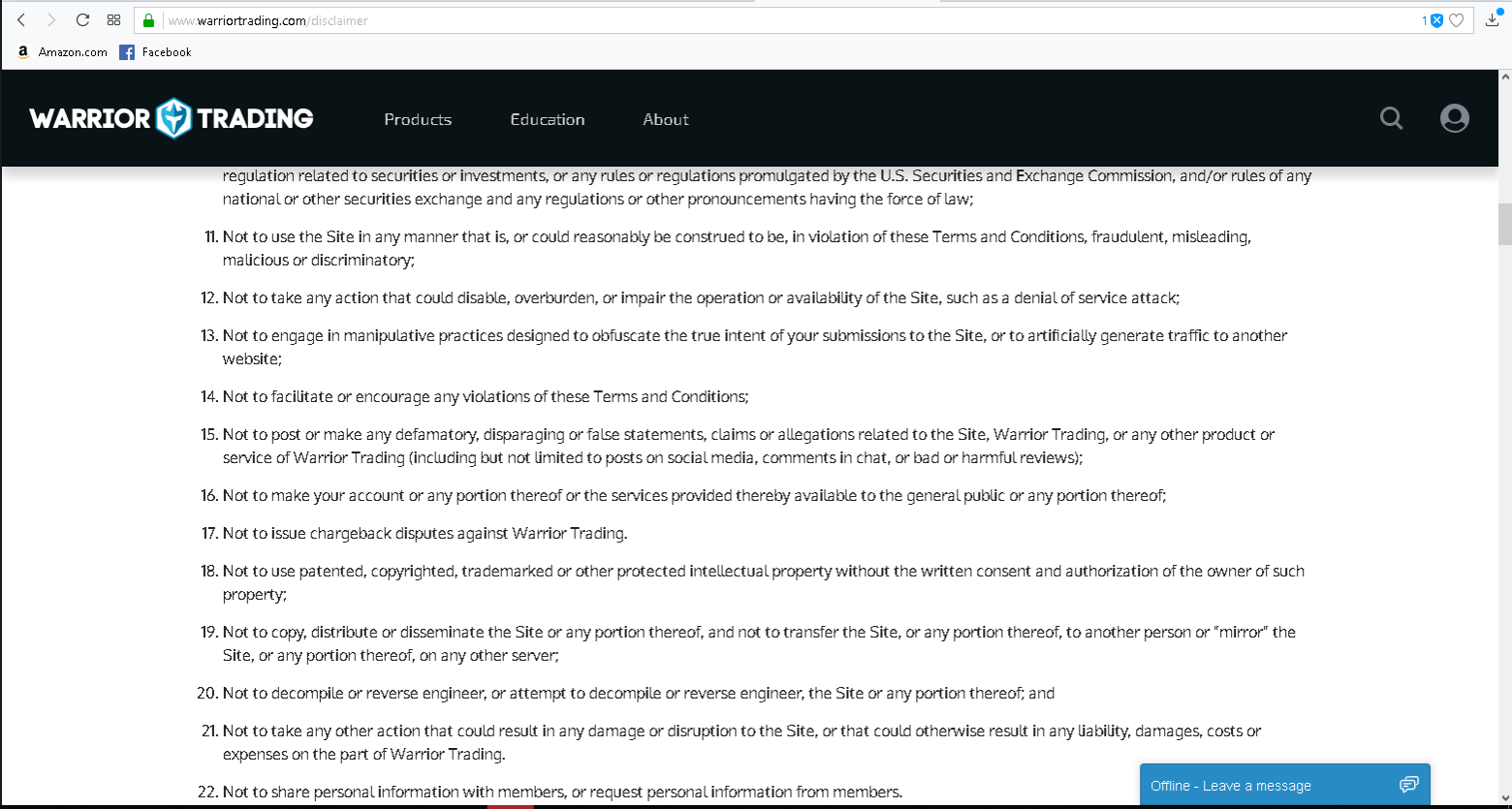
Historical Warrior Trading terms captured January 31, 2019. The excerpt includes restrictions concerning negative reviews and chargeback disputes. This is a separate document from complaint #12; it does not independently establish what happened in that customer’s transaction.

Historical Warrior Trading marketing, Bates WARRIOR TRADING 00087, citing a March 2017 survey: “We help on average 8.5 out of 10 students … become better traders.” Self-reported improvement is not the same as evidence of net trading profits.
A student who said the “live” webinar was not live
On 7 December 2018, a BestStockStrategy student named Francisco wrote that he joined a Warrior Trading webinar advertised as live, concluded it was “super fake and set up,” asked Ross about it in a live-stream chat, and was banned and blocked. His words: “I felt cheated and lied to.” This is one student’s account, not a finding. It is here because it is a dated, first-party report of the same presentation problem the marketing pages above are built on.

Student message, 7 December 2018. Highlighted line: “I felt cheated and lied to.”
Ross Cameron Net Worth: Trading Profits or Course Sales?
What is Ross Cameron's net worth?
Ross Cameron's net worth is not public. In my opinion, it could be upwards of $35 million. That is my estimate, not a verified figure, and I believe most of it comes from Warrior Trading's courses, chat-room subscriptions and simulator fees rather than from trading profits.
However, the source of this wealth is a subject of debate.
+ The Marketing: Warrior Trading's website says Ross turned a $583.15 starting balance (January 1, 2017) into $18,810,638 in total trading gains by the end of December 2025. Those are Warrior's own figures, and gross trading gains are not the same thing as net worth.
+ The Reality: The FTC complaint alleged that Warrior Trading made misleading claims about the potential for consumers to earn money.
The "Guru" Business Model:
While students often lose money, according to the FTC's allegations and one broker's published statement, the business of Warrior Trading is incredibly lucrative. Between course fees, chat room subscriptions, and simulator costs, the company generates massive revenue regardless of whether the students win or lose.
It is our opinion that the vast majority of Ross Cameron’s net worth is likely derived from marketing and subscriptions, rather than the scalable application of his trading strategy.
Professional Associations: The Raging Bull Connection
Before Warrior Trading became a household name, Ross Cameron was associated with Raging Bull.
FTC lawsuit against Raging Bull (alleging $137 million in consumer losses)
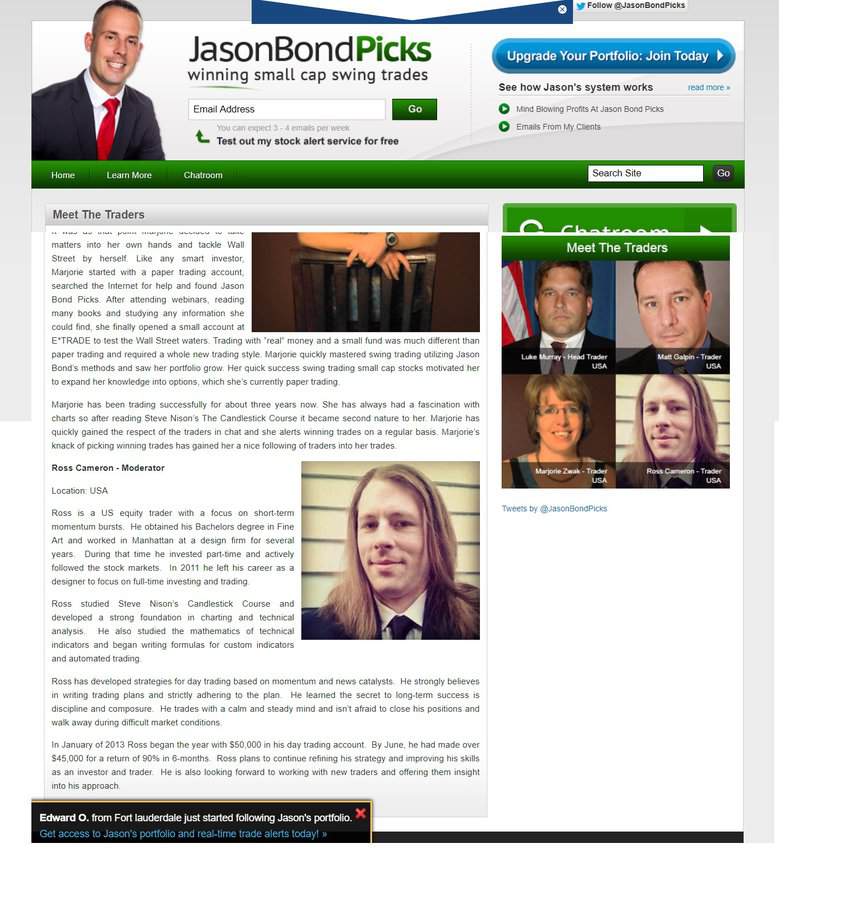
Cameron’s bio on that site described a Fine Art degree and a designer job in Manhattan, then “left his career as a designer to focus on full-time investing and trading.” It did not describe him as a registered architect. Raging Bull later drew its own FTC action; that is a separate case. The overlap that matters here is the marketing model, not guilt by association.
The “NYC Architect” claim
Warrior Trading has marketed Cameron’s story as “From NYC Architect to Day Trader.” His own bio said he worked at a New York design firm from 2006–2010 and left “before completing my exams and become a registered Architect.” The New York State Education Department issued a certification dated 20 October 2017 that a search of its records found no architecture license in the name of Ross Cameron. An earlier bio, written when he was a moderator at Jason Bond Picks, describes a Bachelors degree in Fine Art and a career as a designer — with no mention of architecture.
Brokerage Data: Do Students Make Money?
Beyond the allegations in FTC's complaint, industry insiders have commented on the performance of Warrior Trading students.
The FTC’s complaint states that “the vast majority of customer accounts actually lost money, with numerous consumers losing thousands of dollars trading on top of the thousands they paid Warrior Trading.” This is an allegation in the FTC’s complaint, which describes its analysis of customer brokerage records. The case ended in a $3 million settlement, not a trial establishing every allegation as fact.
SureTrader — a brokerage founded by Guy Gentile and used by many Warrior Trading students — published a blog post stating that nearly all clients referred to SureTrader by Warrior Trading lost money, and that even with zero commissions and fees they would still have had a net loss.
SureTrader has since ceased operations and the post is no longer online; the quotation is preserved in a contemporaneous 2017 screenshot.
The historical SureTrader statement and the FTC’s complaint both raise concerns about customer profitability. They involve different sources and potentially different customer groups, so they should not be treated as a single dataset or a current success-rate estimate.
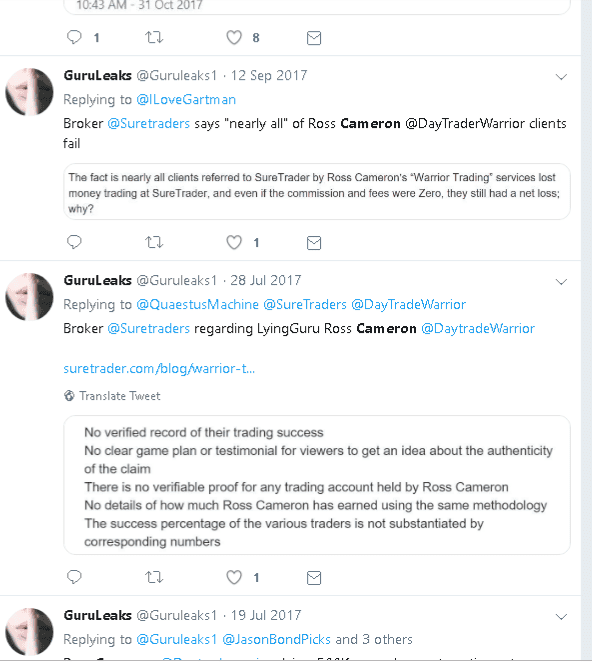
This data aligns with the FTC's allegation that Warrior Trading's marketing exaggerated the likelihood of student success.
Historical Background: Former Co-Founder Jeffrey Fortis
Case disposition: The court history summarized below distinguishes the dismissed sexual-penetration and child-molesting counts from the two misdemeanor counts under California Penal Code §647(a) to which Fortis pleaded guilty.
While Ross Cameron is the public face of the brand, corporate filings tie the company’s history to Jeffrey Peter Fortis.
Fortis is a former Colusa County police detective. A shareholder agreement allocated Warrior Trading’s 1,540 shares between Cameron (1,078) and Fortis (462), roughly 30% — a substantial owner, not a hired instructor.
Court documents obtained by BestStockStrategy reveal a disturbing background. Jeffrey Fortis was charged with a felony including Sexual Penetration of a minor and misdemeanor Child Molesting.
A forensic examination of the seized computers was conducted by the Marysville Police Department at the request of the Yuba County Sheriff's Office.
The examiner reported keyword hits indicating someone using the computer had searched for terms relating to child pornography, while also recording that the hits were few in number and that no such images were found on the devices.
A later evidence-release motion filed in the case states that all computers and cellular phones seized were forensically examined and were not found to contain evidence of further crimes.
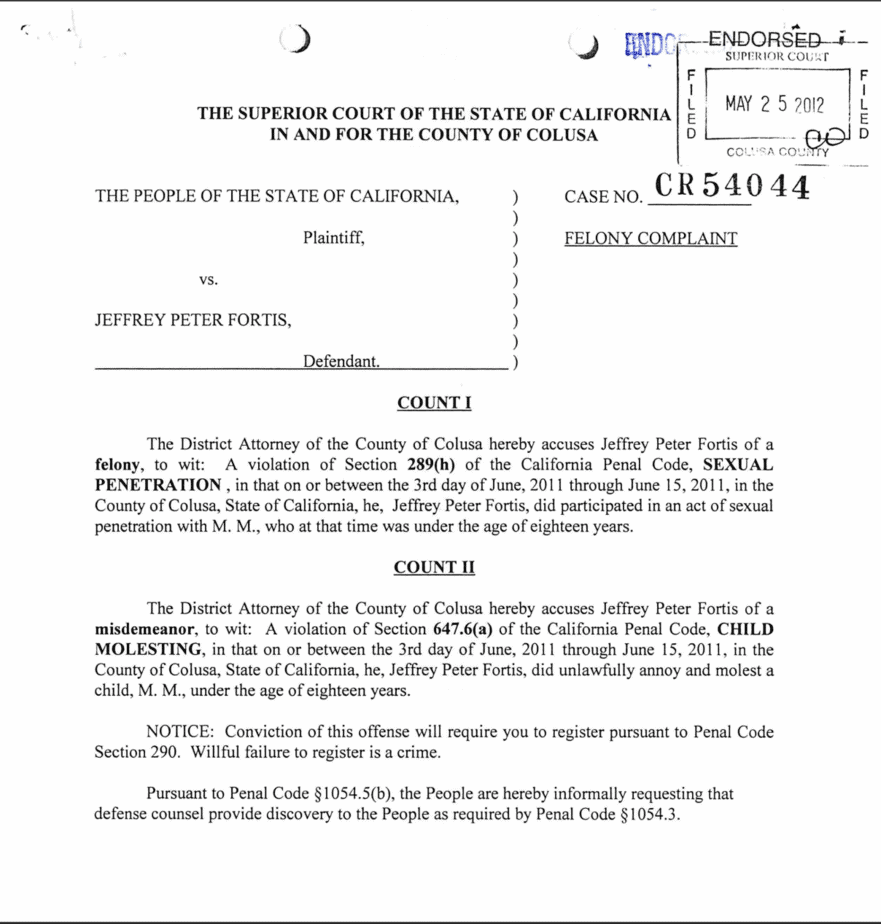
Public records showing charges against Warrior Trading Co-Founder Jeffrey Fortis
The case was prosecuted in Colusa County Superior Court (Case No. CR54044). The felony complaint was endorsed on 25 May 2012, charging four counts arising from conduct alleged between 3 and 15 June 2011. On 3 April 2013, Count 1 (PC 289(h), sexual penetration) and Count 2 (PC 647.6(a), child molesting) were DISMISSED, and Fortis entered a plea of guilty to two misdemeanor counts under California Penal Code Section 647(a). On 5 June 2013, imposition of sentence was suspended and he was placed on 36 months' probation, with conditions including no contact with the victim and no unsupervised contact with minors.
The Wrongful Termination Lawsuit:
Fortis later sued Warrior Trading for wrongful termination. In that civil suit, Warrior Trading’s defense alleged that Fortis was fired for cause due to various issues, including:
- Offering cocaine to another employee at a work function.
- Possessing a firearm in the workplace.
- Unauthorized use of company funds.
Read the Public Records:
+ Jeffrey Fortis Felony Complaint (PDF)
+ Civil Litigation between Fortis and Warrior Trading / Ross Cameron (PDF)
Warrior Trading vs. Free Speech: The Emmett Moore Case
Warrior Trading has a history of litigating against critics. However, they do not always win.
In the case of Cameron vs. Moore (Case No. CV CV 17-1538, Yolo County Superior Court, Department Three — tentative ruling issued 1 March 2018), Ross Cameron and his company sued an individual named Emmett Moore.
The Result: On March 1, 2018, the Superior Court of California issued a Tentative Ruling and GRANTED Emmett Moore's Anti-SLAPP Motion (Strategic Lawsuit Against Public Participation). The court found that the complaint arose out of the defendant's protected speech. That ruling was subsequently adopted as final.
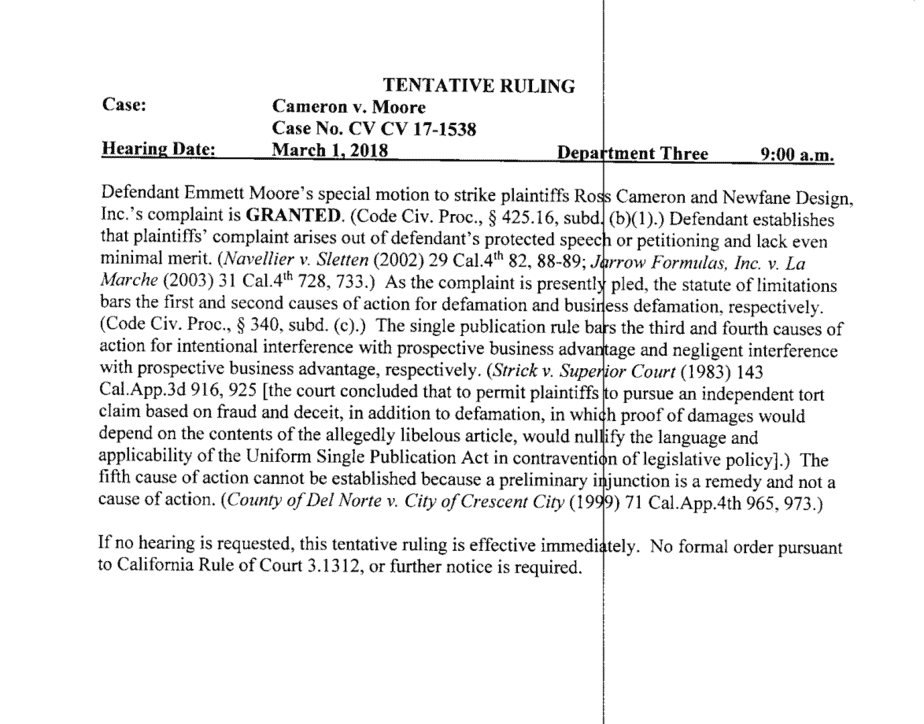
This ruling is significant because Anti-SLAPP laws are designed to prevent companies from using lawsuits to silence valid public criticism.
This was not the only time Warrior Trading used lawyers against critics. On 5 September 2017, McDonald Carano, writing as counsel for Warrior Trading, sent Michael Marchi a cease-and-desist letter demanding he remove posts on tradingschools.org that called the company a “fraudulent site” and Cameron a “con artist,” and threatening suit if he did not confirm by 8 September 2017. A demand letter is not a finding. It is here because it is the same playbook as Cameron v. Moore — pressure first, merits later — and in Moore’s case the court said the suit lacked even minimal merit.
A Better Way: The "Financed Bull" Strategy
The FTC action and the failure rates cited by brokers highlight the extreme difficulty of day trading.
At BestStockStrategy, we teach the "Financed Bull" strategy, built on options math rather than day-trading volatility. We buy call debit spreads and finance them by selling puts on high-quality companies. The put premium can pay for part or all of the spread, so you participate in the upside with defined risk on the spread, while accepting real downside risk on the short put, which is why position size matters.
----
A Better Fit Than Day Trading
I've compared options trading vs. day trading in detail. In my opinion, selling option premium with defined-risk hedging is a far better fit for most people than day trading small caps.
Learn a strategy that prioritizes capital preservation and mathematical probability.
→ Try the Financed Bull Strategy (14-Day Trial)
---
Consumer Resources
If you have concerns about a trading product, you can contact the following agencies:
+ Federal Trade Commission: Report Fraud
+ SEC Whistleblower Program: Submit a Tip
+ Find Your State Attorney General: State AG Directory
+ Better Business Bureau: File a Complaint
+ Consumer Financial Protection Bureau: File a Complaint (billing and credit-card disputes)
Conclusion: Warrior Trading and Ross Cameron Review
Ross Cameron is a skilled marketer and a genuinely capable day trader. That is not the question. The question is whether his students make money — and the FTC's complaint, along with brokerage data from a firm that served them, suggests most do not.
Given the FTC's allegations about customer losses, and since in my opinion virtually all day traders end up losing money, Warrior Trading is likely no worse than Humbled Trader, ZipTrader, Steven Dux or TJR Trades / Tyler Riches.
Warrior isn't the only one charging a premium for content you may be able to find for free — read my Peachy Investor (Brittney Pernell) review
Warrior Trading isn't the only day-trading educator worth scrutinizing. See my breakdown of whether Humbled Trader's Shay Huang is legit — a course business that, in my opinion, runs on memberships rather than trading profits.
See also my review of Investing With Brandon (Brandon Arnett).
Warrior Trading and Ross Cameron Frequently Asked Questions (FAQs)
Is Warrior Trading legit?
Warrior Trading is a real company and Ross Cameron is a real day trader. The question for buyers is student results: the FTC's 2022 complaint alleged that most customer accounts lost money, and the company paid $3 million to settle without admitting or denying the allegations. In my opinion, it is not worth paying for.
What was the Warrior Trading lawsuit?
In April 2022 the FTC sued Warrior Trading, Warrior Operating and Ross Cameron, alleging deceptive earnings claims. The case ended in a stipulated order with a $3 million monetary judgment for consumer refunds and a permanent injunction. The defendants did not admit or deny the allegations. In January 2023, the FTC sent more than $2.9 million in refunds to 20,402 people.
What is Ross Cameron's net worth?
It isn't public. In my opinion it could be upwards of $35 million (my estimate, not a verified figure), and I believe most of it comes from courses, chat-room subscriptions and simulator fees rather than trading profits.
Is Warrior Trading worth it?
In my opinion, no. Day trading small-cap stocks loses money for most retail traders, and the FTC's allegations and a broker's own published statement both point the same way for Warrior students.
Do Warrior Trading students make money?
The FTC's complaint alleges that the vast majority of customer accounts lost money. SureTrader, a broker many students used, published a 2017 post saying nearly all clients referred by Warrior Trading lost money. The two sources cover different groups, so treat them as separate warning signs, not one dataset.
How much does Warrior Trading cost?
Pricing changes, so get the current offer and its renewal terms in writing. Historical complaint records show one consumer who saw an advertised $497 price and was charged $785 in total, and another who paid $3,009.30 for education plus $997 for community access.
Was Ross Cameron an architect?
New York's Education Department issued a certification in October 2017 that it found no architecture license in his name. His own earlier bio described a fine-art degree and a designer job, and said he left before completing his architecture exams.
Who is Jeffrey Fortis?
A former Colusa County police detective who held about 30% of Warrior Trading's shares. In 2013 he pleaded guilty to two misdemeanor counts after the felony counts against him were dismissed. He later sued Warrior Trading for wrongful termination.
Has Warrior Trading sued its critics?
Yes. Ross Cameron and his company sued Emmett Moore in 2017, and the court granted Moore's anti-SLAPP motion in 2018. Separately, in 2017 a law firm acting for Warrior Trading sent a cease-and-desist letter over critical posts on tradingschools.org.
What is a better alternative to Warrior Trading?
For most people, a slower, rules-based approach fits better than day trading. I sell option premium with debit-spread hedging (Financed Bull) on large-cap stocks and publish my E*TRADE statements. My free training explains the framework.
Source Documents & References:
3) Local press coverage of the Fortis case (Daily Democrat screenshot, with third-party annotations) — reports that Fortis is a former Colusa County police detective: Daily Democrat coverage of Jeffrey Fortis (screenshot, with third-party annotations)
4) Fortis sued Warrior Trading alleging wrongful termination. The linked filings include the company’s stated reasons for termination; those assertions should be distinguished from court findings: Fortis v. Warrior Trading, 2:19-cv-00627 (E.D. Cal.) — filings and termination letter
7) SureTrader's 2017 blog post said that "nearly all" clients referred by Warrior Trading lost money: 2017 screenshot of SureTrader blog: nearly all Warrior Trading referrals lost money
8) Guy Gentile's (Founder of Suretrader) thoughts on Warrior Trading: Guy Gentile post on Warrior Trading (opinion screenshot)
9) More info about Warrior Trading students potentially losing money: Additional SureTrader / student-loss screenshot
10) Ross Cameron and Warrior Trading sued a critic and lost an anti-SLAPP motion in California: Cameron v. Moore, Yolo County CV CV 17-1538 — anti-SLAPP ruling
11) Message that Warrior Trading sent to their members when they were under FTC investigation: Warrior Trading member email disclosing the then-non-public FTC investigation
12) Ross Cameron used to work with Raging Bull (sued by the FTC, which alleged $137MM in consumer losses): Ross Cameron’s moderator bio at Jason Bond Picks / Raging Bull
13) Warrior Trading claims that 80% of their members are profitable (the FTC's complaint alleges the opposite): Swing Trade Warrior About page claiming the community is over 80% profitable
14) Consumer complaint records released by the FTC under FOIA (allegations, not findings): - Read the 22 complaint records from the FTC's FOIA production (2018–2021), compiled by BestStockStrategy
Disclosure: I sell options education and trade alerts and compete in this market. This review distinguishes my observations, public records, customer reports, and opinion. Customer complaints are not, by themselves, findings of wrongdoing.