
QUICK VERDICT: Piranha Profits Review
Adam Khoo is a legitimate, long-established financial educator — not a fraud, and not an anonymous penny-stock pumper. His free YouTube content is genuinely useful for beginners, and he deserves credit for abandoning retail forex years ago. But that's the free stuff. The paid Piranha Profits funnel is a different story: the courses cost roughly $1,000–$3,000 for information you can find free, the paid subscription playbooks run by his mentors have badly underperformed the S&P 500, the marketed "5–20% per month" trading returns are mathematically implausible, and his verifiable trading record only goes back a few years despite a claimed 30-year history. Most tellingly, his wealth comes from selling education and seminars — not from trading.
Free content = Worth watching
Paid courses and playbooks = Skip them.
Are Adam Khoo and Piranha Profits legitimate? It's one of the most-searched questions about any Singaporean financial educator, and the honest answer is more nuanced than a simple "scam" or "guru" label.
I'm David Jaffee. I've reviewed dozens of trading educators, and I try to grade them on a single question: does this person's content help the viewer, or hurt them? When I first reviewed Adam Khoo years ago — back when he was teaching retail forex — I graded him poorly, because I believed his followers would lose money. He later changed course, and I changed my grade to a positive one. I stand by that revised opinion of his free material.
This review is an update, and it's more critical — not because Adam has gotten worse, but because I finally looked closely at what he actually charges for. There's a large and important gap between his free YouTube channel and the paid Piranha Profits ecosystem, and most people researching him never see that gap until after they've paid.
Let me show you both sides.
Get the Complete Framework — Free
Get $400+ of free options trading training and the Trader's Edge cheat sheet. Join 127+ five-star reviewers. No credit card required.
Key Takeaways
- Adam Khoo is a real, named, 20+-year Singaporean educator with no regulatory action from MAS or any U.S. regulator. This is not a fraud case — the critique is about value, not legality.
- His free YouTube content is genuinely good for beginners, and he deserves credit for moving off retail forex. The problem is the paid products, not the free ones.
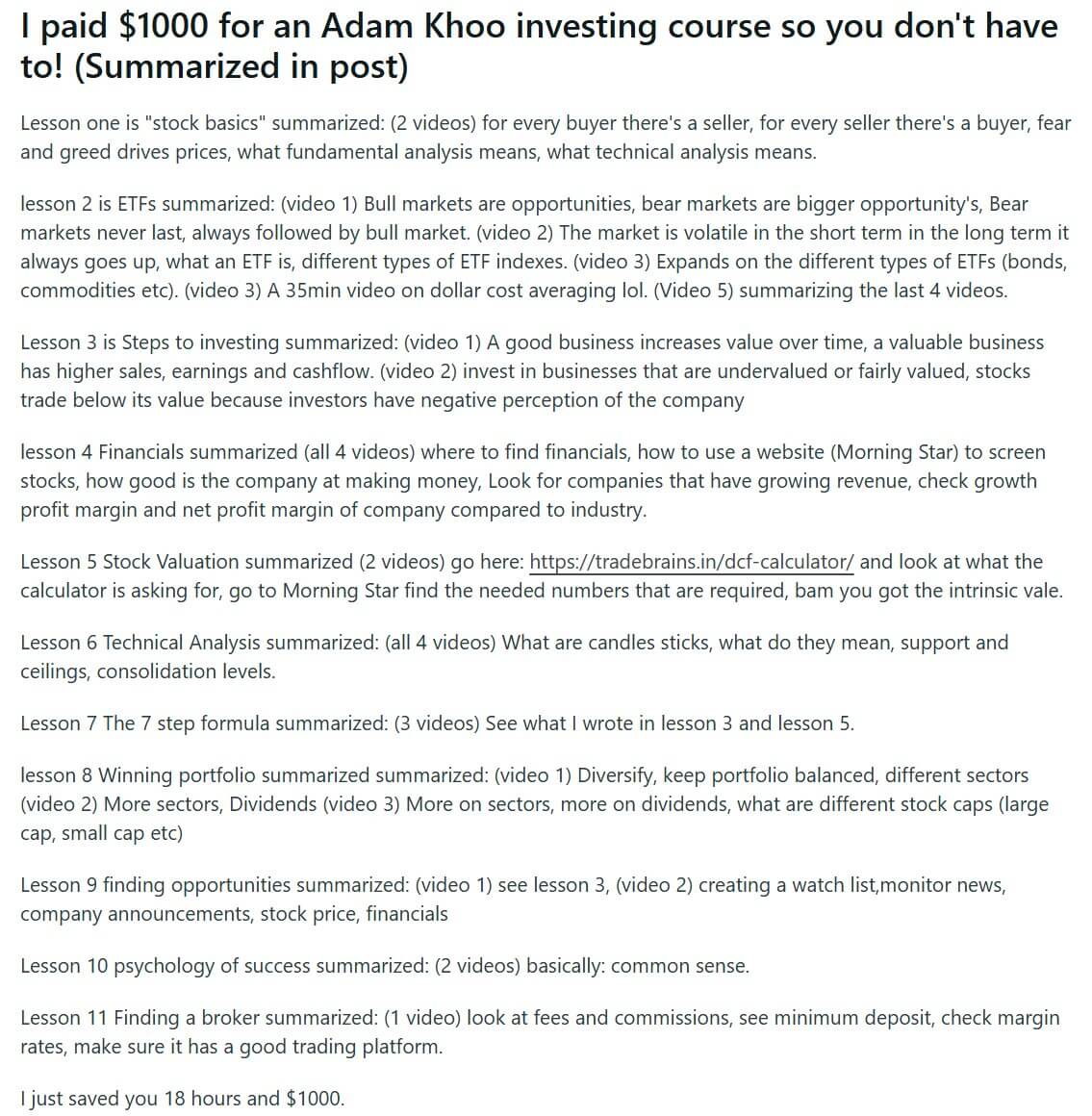
- Piranha Profits courses run ~$1,000–$3,000 for material reviewers describe as freely available beginner content — the viral "I paid $1,000 so you don't have to" Reddit breakdown summarized the whole curriculum in a few paragraphs.
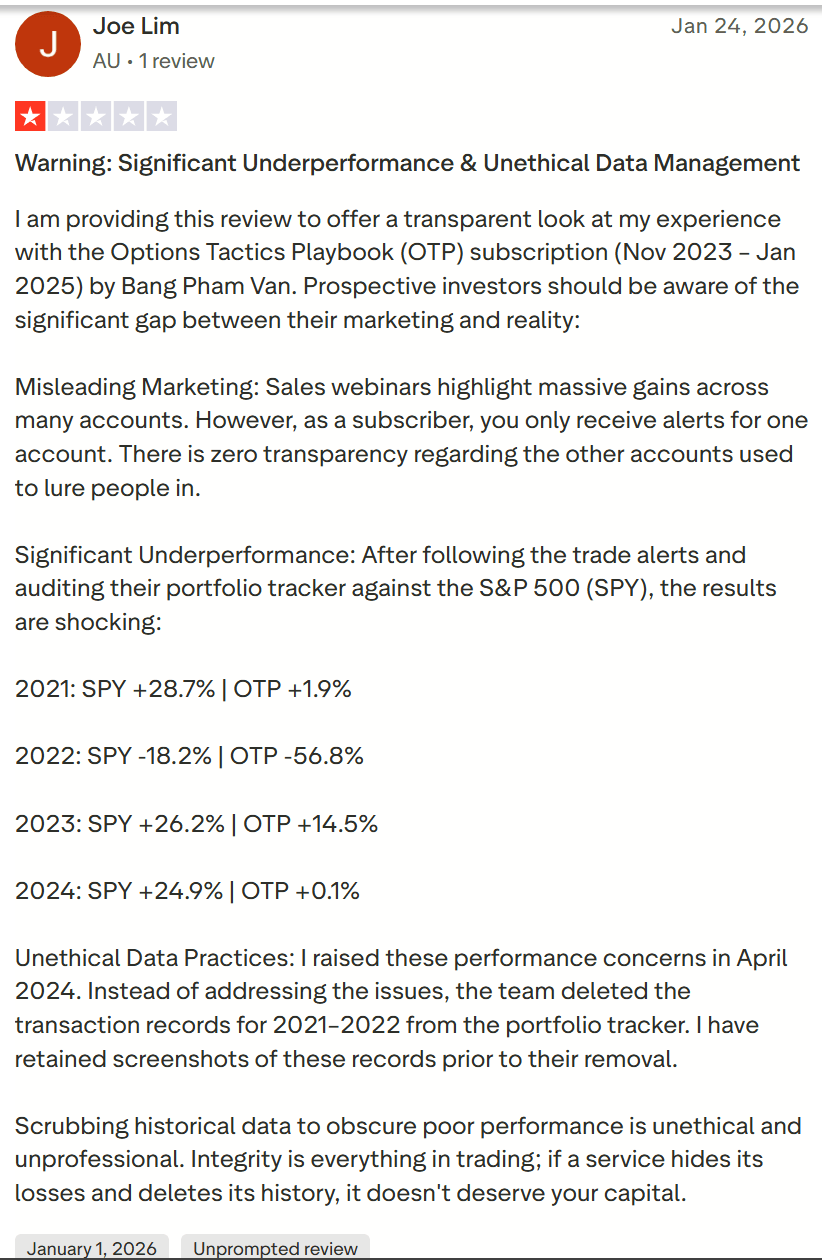
- The paid playbooks underperformed badly: a subscriber documented the OTP playbook at +1.9% vs the S&P's +28.7% (2021) and −56.8% vs −18.2% (2022) — with the 2021–2022 records allegedly deleted after he complained.
- The PAM playbook showed a documented 30–42% win rate against an advertised 60%, plus a $50,000 account top-up that masked an early drawdown.
- His marketing dangles 5–20% per month — a mathematically impossible compounding rate that's flatly contradicted by his own platform's sub-2%-per-year playbook results.
- His long-term record is unverified: he claims 30+ years (since 1991) but only displays results from ~2019, and reviewers call him a "reverse indicator" for bag-holding Alibaba, Estée Lauder, and Tesla.
- His ~$50M net worth comes from selling education (~$30M/yr combined business turnover) — not from trading. The "rags-to-riches" story is undercut by a well-off father.
- The fortune began with Edusave-funded student "motivation" workshops — the documented "imagine your parents dead" sessions — the same manufacture-emotion-then-monetize pattern now aimed at retail investors.
- The better way: instead of paying to chase impossible monthly returns, sell options premium for realistic, defined-risk monthly income — backed by verified +78%/+67% E*TRADE results.
First, the part where I give Adam Khoo credit (the concede)
I want to be fair, because fairness is the whole point of an honest review. Here's what Adam Khoo genuinely gets right.
Watch my earlier video review below, where I explain why I upgraded my opinion of his free content:
He stopped pushing retail forex. Years ago, Adam was a forex trader, and retail forex is one of the fastest ways for a beginner to lose money. He moved away from it and toward value investing in large, established companies with strong balance sheets. That was a real improvement, and it's why I revised my grade upward.
His free YouTube content is actually good. I spent hours watching his channel, and his stock breakdowns are surprisingly detailed. Even his critics concede this. As one Reddit commenter put it, his videos teach you how to fish rather than handing you stock tips — the basics of evaluating a company, thinking long-term, and not day-trading your savings away. For a complete beginner, that's a reasonable free education.
His core philosophy is sound. Own quality businesses. Don't gamble. Buy good companies when they're cheap. Be patient. None of that is controversial, and none of it will blow up your account. There's nothing wrong with the foundation.
He's a real, established businessman — not an anonymous fraud. Adam Khoo has run businesses in Singapore for over twenty years, has written 16 best-selling books, and operates under his real name with a real company. There is no regulatory action against him from the Monetary Authority of Singapore or any U.S. regulator. In fact, when people search "Adam Khoo scam," much of what they find is Adam himself warning his followers about impersonator accounts that DM people pretending to be him. He's on record saying he never private-messages strangers and never trades on anyone's behalf — and that's accurate and to his credit.
So if you're here wondering whether Adam Khoo is going to steal your money or run off with your account: no. That's not the concern.
The concern is narrower, and it starts the moment you reach for your credit card.
Now the part most reviews skip: the paid Piranha Profits funnel
Everything above is about the free content. Piranha Profits, his online trading school, is the paid business — and it's where the picture changes. Here are the documented problems.
1. The courses are overpriced for information that's freely available
Piranha Profits course bundles run roughly $1,000 to $3,000. The flagship Whale Investor course (his "Value Momentum Investing" method) has sold to thousands of students at promotional prices around $1,500.
What do you get for that? According to one of the most-upvoted breakdowns on Reddit — a post bluntly titled "I paid $1,000 for an Adam Khoo investing course so you don't have to" — the answer is roughly eighteen hours of beginner material: what a stock is, what an ETF is, dollar-cost averaging, how to read a candlestick, and how to pick a broker. The poster summarized the entire curriculum in a few paragraphs and concluded it was essentially free Investopedia content stretched across dozens of long videos.
That's the recurring complaint across review sites and forums: the information isn't wrong, it's just not worth four figures, because it's the same fundamentals you can learn free on YouTube — including on Adam's own channel. You're paying a premium for organization and a community, not for any genuine edge.
It's the same overpriced-course pattern I documented in my Umar Ashraf and TradeZella review and my ZipTrader review: premium prices for fundamentals you can get free.
2. The paid playbooks have badly underperformed the market
This is the most damaging part, and it's specific.
Piranha Profits doesn't just sell courses — it sells subscription "playbooks" where you follow a mentor's live trades. The two best-documented are the Options Tactics Playbook (OTP), run by mentor Bang Pham Van, and the Price Action Manipulation (PAM) playbook, run by mentor Alson Chew.
A detailed Trustpilot reviewer who subscribed to OTP from late 2023 audited the portfolio against the S&P 500 and documented the gap year by year: OTP returned roughly +1.9% when the S&P returned +28.7% (2021), and −56.8% when the S&P fell only −18.2% (2022). The same reviewer alleged that after raising these performance concerns, the team deleted the 2021–2022 transaction records from the portfolio tracker — and said they'd kept screenshots.
The PAM playbook fared no better in reviewers' accounts. One subscriber documented a real-world win rate of 30–42% against an advertised "60% winning chance," with steep drawdowns that students were never warned about — and noted that the mentor injected a fresh $50,000 into the account after an early 20–25% drawdown, which conveniently made the percentage results look healthier than a normal student's account would.
These are the paid, premium products — the ones the courses funnel you toward. To be fair, these playbooks are run by his mentors rather than Adam personally. But they're sold under his brand, on his platform, marketed off his name. That's his ecosystem, and the results inside it have lagged a simple index fund.
3. The "5–20% per month" trading claim is implausible
In his popular "Stock Investing Versus Trading" presentation, Adam shows a slide contrasting investing (10–25% per year) with trading (5–20% per month). The monthly figure is the marketing hook for the trading courses.
Do the math on what 5–20% per month actually means. As one r/Daytrading thread walking through it points out: $10,000 compounding at 20% per month becomes over a million dollars in about two years, and over a billion within five. Nobody on Earth sustains that. The best hedge funds in history — Renaissance, Citadel — would struggle to clear 20% in a year. If a Singaporean educator could truly compound 5–20% monthly, Ken Griffin would be calling him, not the other way around.
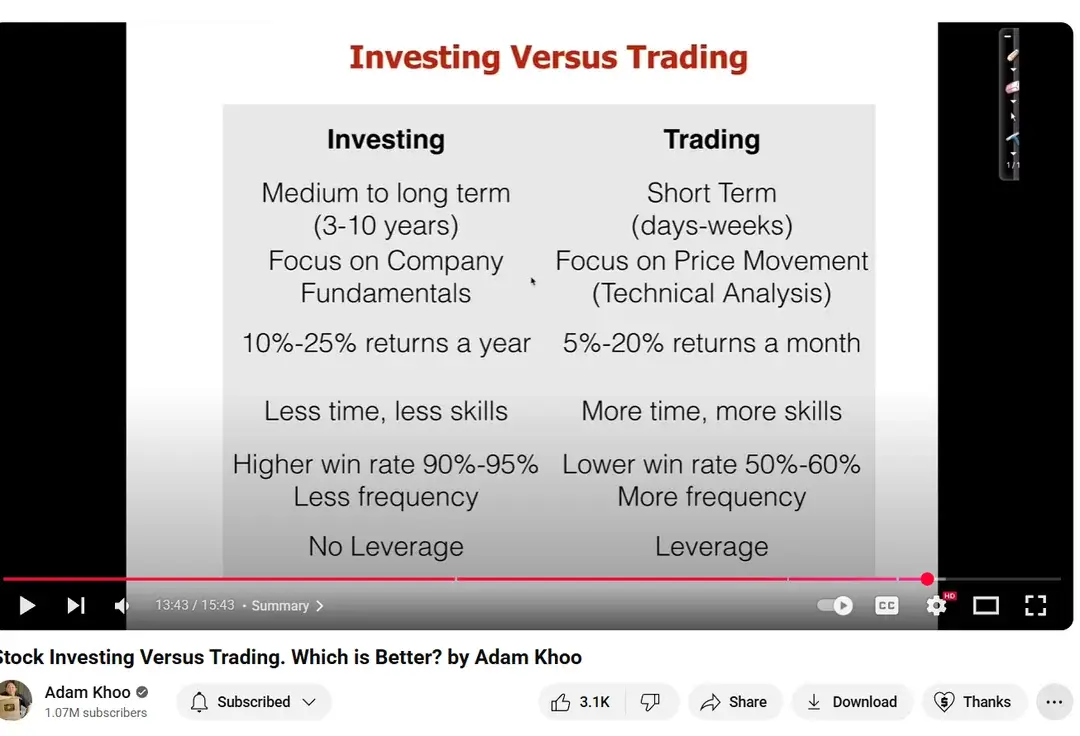
A return ceiling like that isn't a track record. It's a "what's possible if you're great" number presented in a way that beginners read as an expectation. That's the problem.
And here's the tie that binds the whole review together: the marketing dangles 5–20% per month — but the documented reality from his own platform's flagship playbook (see Reason 2) was roughly +1.9% across the entire year in 2021, while the S&P 500 returned +28.7%. A service advertising up to 20% a month delivered under 2% in twelve months and trailed a simple index fund by more than 25 percentage points. That gap — between the number used to sell you and the number you actually get — is the entire story of the paid funnel.
4. The long-term track record is unverified
Adam markets himself as having "over 30 years of market experience" and says he's been investing since 1991. But the actual results he displays only go back to roughly 2019–2020 — right at the start of one of the strongest bull markets in history.
Long-time followers have noticed. Multiple reviewers describe him as a reverse indicator who has spent years bag-holding underperformers — Alibaba, Estée Lauder, Tesla — and who tends to tell students to "buy and hold" while positions fall, then paper-hand at the bottom. One detailed account described doubling down on his recommendations near the 2022 peak and watching the portfolio drop sharply while the advice stayed "buy and hold."
The pattern reviewers describe: if you followed him at the start of a bull year, you made money like everyone else did. If you followed him near a top, you got hurt. That's not a verified, audited, decades-long record. It's a few good years during a rising tide.
See the Strategy Live
Real-time options alerts from a verified Wall Street trader with +78% multi-year returns. 14-day trial available.
Follow My Trades with Real-Time Trade Alerts
5. The "proof" is self-referential
The UIP subscription is marketed on the idea that, unlike "academic analysts with no skin in the game," Adam reveals his actual portfolio — every holding, purchase date, and return — "no demo account, no cherry-picked examples."
That sounds compelling, but it's still his own unaudited portfolio reveal. There's no independent third party verifying the numbers, no broker-issued statement, no auditor. "Trust me, here are my screenshots" is not the same as a verified track record, no matter how transparent it's framed. Screenshots and manually maintained trackers can be curated — which is exactly what the OTP reviewer alleged happened when inconvenient records disappeared.
It's the same problem as Tim Sykes' self-owned Profit.ly: when the "proof" is graded by the same person selling the course, it isn't proof.
6. The net worth comes from selling education — not from trading
This is the quiet tell that runs through the whole operation.
Adam Khoo's businesses — led by Adam Khoo Learning Technologies Group — generate a reported ~$30 million in combined annual turnover from seminars, courses, books, and corporate training. His investment portfolio, by his own platform's description, is in the eight figures. Estimates of his total net worth vary wildly, from his own claim of roughly $18 million to third-party figures around $50 million.
My estimate is around $50 million — and the overwhelming majority of it comes from selling financial education, not from trading the markets. That ordering matters. If trading were the reliable money-maker he markets it as, the courses would be a rounding error. Instead, it's the other way around: the courses are the business, and the trading is the marketing.
It's also worth puncturing the "self-made" narrative gently. Adam's father owned an advertising agency, and multiple Singaporeans recall the family home having a private swimming pool. He had a real head start. That doesn't diminish what he built — but "rags to riches" it was not.
7. Where the fortune actually started: the student-workshop history
Long before Piranha Profits, Adam Khoo's fortune was built on school motivational workshops — the "SuperTeen" and "I Am Gifted" programs sold to Singaporean schools and parents, often paid for with government Edusave funds.
These workshops are remembered by a generation of Singaporean students, and not fondly. Across hundreds of accounts on r/singapore, r/SGExams, and elsewhere, former 12-to-16-year-old attendees describe the same thing: lights dimmed, somber music, instructors telling children to imagine their parents dead on the floor — emotional blackmail designed to "motivate" them to study harder. A news write-up documented the parents-on-their-deathbeds visualization exercise directly.
The methodology has been criticized as resting on neuro-linguistic programming, a pseudoscience, with trainers — often barely older than the students — speaking with false confidence about mental health they weren't qualified to address. One detailed former-student account describes a trainer dismissing a teenager's disclosure of self-harm with a joke.
Why does this belong in a trading review? Because it tells you where the money came from and reveals a consistent pattern: manufacture an emotional response, then monetize it. First it was anxious parents and schoolchildren. Now it's retail investors who want to believe 5–20% a month is real. The product changed. The playbook didn't.
8. The business model is misaligned with your success
Here's the structural problem underneath all of it. Adam Khoo gets paid when you buy a course or renew a subscription — not when you actually make money in the market.
A course seat is sold whether you profit or blow up. A UIP renewal (annual only, with auto-renew and no trial) is charged whether his picks beat the S&P or trail it. The incentive is to keep you subscribed and to keep selling the next bundle — options, REITs, crypto, the next playbook — not to make you a self-sufficient investor who no longer needs him. That misalignment doesn't make him a criminal. It makes him a salesman first and an investor second, which is exactly what the most clear-eyed reviewers conclude.
A Better Way: Get Paid Instead of Paying
Here's the irony at the center of every overpriced trading course. The people selling you "how to make money trading" are making their money from the course — because consistent trading profits are genuinely hard, and selling education is genuinely easy.
I take the opposite approach, and I think it's more honest.
Instead of chasing 5–20% a month (which doesn't exist) or paying four figures to learn what a candlestick is, I focus on selling options premium on high-quality, stable companies. When you sell premium, you collect income up front and time works for you instead of against you. The goal isn't to get rich next month — it's to generate consistent, realistic monthly income (think a few percent a month, not twenty) while taking defined, manageable risk.
It's the difference between gambling on direction and running a disciplined income strategy. One is a casino. The other is a business.
Piranha Profits (Adam Khoo) | BestStockStrategy (Financed Bull) | |
|---|---|---|
Track record | Self-reported, unaudited screenshots, only since ~2019 | |
Strategy | Buy-and-hold picks + mentor "playbooks" | Selling option premium with debit-spread hedging (Financed Bull) |
Returns marketed | "5–20% per month" (impossible to sustain) | Realistic few-percent monthly income, risk-first |
Cost | ~$1,000–$3,000 courses + annual auto-renew subs | Transparent membership with a 14-day trial |
Proof | "Trust my screenshots" (self-owned, editable) | Real brokerage statements + 127+ five-star reviews |
Who actually profits | The course/subscription seller — win or lose | You do — you keep the premium income yourself |
You can read the full framework here: Selling Options Premium for Consistent Income — or start with my pillar guide to options trading strategies.
Looking for a Legitimate Options Trading Education?
If you're researching trading educators because you've been burned (or want to avoid being burned), here's what actually works.
I'm a former Wall Street investment banker — I interned at Morgan Stanley, then worked at CIBC World Markets and Petsky Prunier. I generate verified +78% and +67% returns on real E*TRADE accounts, fully documented at my verified results page.
The strategy that actually works isn't paying for expensive courses from educators without an independently verified record, or following unaudited "playbooks." It's selling options premium for consistent monthly income on high-quality stocks.
Read my guide to Selling Options Premium for Consistent Income — or join the 127+ five-star reviews from members who follow my real-time trade alerts.
Consumer Resources: Protect Yourself Before You Pay for Any Trading Course
Before you hand money to any financial educator — Adam Khoo or anyone else — use these free, official resources to do your own due diligence:
- FINRA BrokerCheck — verify whether a person or firm is registered and check their disciplinary history.
- SEC Investor.gov — the SEC's free education and fraud-prevention hub; check the "Check Your Investment Professional" tool.
- CFTC SmartCheck — for anyone touching forex, futures, or options.
- Monetary Authority of Singapore — Financial Institutions Directory — for Singapore-based educators and firms, confirm what they are and aren't licensed to do.
- FTC Consumer Advice — how to spot and report deceptive "get-rich-quick" marketing.
A simple rule: if someone's primary income comes from selling you the secret to making money, ask why they're not just using the secret themselves.
2026 Status Update
As of 2026, Adam Khoo remains highly active. His YouTube channel has crossed one million subscribers, Piranha Profits reports tens of thousands of students across more than 160 countries, and he continues to run the UIP subscription, the Whale Investor course, and the mentor-led options and PAM playbooks. He co-hosts annual events and continues publishing free market-analysis videos.
Nothing in his regulatory status has changed — there's still no enforcement action against him. The criticisms in this review are not about legality; they're about value for money and the honesty of the marketing. The free content remains good. The paid funnel remains overpriced relative to what it delivers, and the playbook performance documented by subscribers remains the strongest reason to keep your wallet closed.
The Bottom Line
Adam Khoo is the rare case where "scam or legit?" is the wrong question. He's legit. He's also selling you something you mostly don't need to pay for.
Watch his free YouTube videos — they're a solid, no-cost beginner education in value investing. Don't pay $1,000–$3,000 for a course that repackages the same fundamentals, and be very skeptical of the subscription playbooks, which reviewers have documented underperforming a basic index fund while marketing 5–20% monthly returns that the math says can't be real.
And remember the structural truth that applies to every educator in this space, including the good ones: the surest money in trading education is made selling the education. The healthiest thing you can do for your portfolio is learn a strategy where you get paid to take risk — not one where you pay to find out the risk was yours all along.
Ready to See Verified Trades and Disciplined Risk Management?
See what our 127+ five-star reviews already know about the Financed Bull Strategy.
Alternatives to Adam Khoo / Piranha Profits (2026)
The best alternative to Adam Khoo's paid courses is one he provides himself — for free.
1. Adam's own free YouTube channel. As this review concedes, his free content has genuine value. In my opinion, the value proposition collapses only when you're asked to pay $1,000–$3,000 for the Piranha Profits courses. Watch free; don't buy.
2. A strategy with published, verified performance. Before paying for any mentor playbook, compare it to a verifiable baseline. My trailing-twelve-month results — +78% and +67% — are verified here, trading selling option premium with debit-spread hedging (Financed Bull).
3. Free structured learning. My free training and strategies guide cost nothing and hold up against, in my opinion, most four-figure course bundles.
Take the Complete Options Trading Course
- Learn the full system so you can trade independently
- Master the complete step-by-step framework
- Understand the “why” behind every trade
- Understand the “why” behind every trade
Frequently Asked Questions
Is Adam Khoo legit or a scam?
Adam Khoo is legitimate. He's a real, named, long-established Singaporean financial educator with no regulatory action against him, and he isn't going to steal your money. The valid criticism isn't fraud — it's that his paid Piranha Profits courses are overpriced for freely available information and that the subscription playbooks sold on his platform have underperformed the S&P 500.
What is Piranha Profits?
Piranha Profits is Adam Khoo's online trading school, founded in 2017. It sells video courses (Whale Investor for value investing, plus options courses) and subscription "playbooks" (UIP, OTP, PAM) to tens of thousands of students across 160+ countries. Adam Khoo is founder and lead mentor, alongside Bang Pham Van and Alson Chew.
How much does Piranha Profits cost?
Course bundles run roughly $1,000–$3,000. The UIP subscription, which reveals Adam's portfolio, is billed annually with auto-renewal and no trial period — there's no free way to test the paid playbooks before committing for a full year.
Does Adam Khoo's Value Momentum Investing strategy work?
The underlying philosophy — owning quality companies and buying them cheap — is sound and low-risk. But the displayed results only go back to about 2019, aren't independently audited, and several prominent picks (Alibaba, Estée Lauder, Tesla) badly underperformed. A simple S&P 500 index fund would have matched or beaten it without the course fee.
What is Adam Khoo's net worth?
I estimate Adam Khoo's net worth at around $50 million. The large majority of it comes from selling financial education — his training companies generate roughly $30 million in combined annual turnover from courses, seminars, and books — rather than from trading or investing the markets.
How much of Adam Khoo's net worth comes from trading?
Very little. His own platform describes an eight-figure investment portfolio, but his wealth was built primarily on seminars, courses, books, and corporate training. The trading is largely the marketing for the education business, not the other way around.
Is the "Adam Khoo" messaging me on Telegram or WhatsApp real?
Almost certainly not. Adam Khoo has publicly warned that scammers impersonate him using fake accounts with his photos to solicit money. The real Adam Khoo states he never private-messages strangers, never offers to trade on your behalf, and only sells courses through his official website. If "Adam Khoo" DMs you a money-making opportunity, it's an impersonator — report and block it.
Piranha Profits Review / Is Piranha Profits worth it?
For most people, subscribing to Piranha Profits is NOT worth it. The free YouTube content covers the same fundamentals, and the paid courses ($1,000–$3,000) largely repackage beginner material. The subscription playbooks (OTP, PAM) have been documented by reviewers underperforming a simple S&P 500 index fund. If you want a paid education, look for an educator whose own results are independently verified.
Did Adam Khoo really do the school workshops where kids imagined their parents dying?
Yes. His earlier business included widely documented motivational workshops for Singaporean schoolchildren, where former students describe being asked to visualize their parents' deaths as a "motivation" technique. These accounts appear across hundreds of posts on Reddit and in local news coverage.
This review reflects my professional opinion based on publicly available information, documented customer reviews, and my own experience reviewing trading educators. It is not financial advice. Always do your own due diligence.