

Quick Verdict: Is TJR Trades Legit?
In my opinion, no — TJR Trades is not someone retail traders should trust with their money. Tyler Riches presents himself as a self-made twenty-something millionaire who went from "broke DoorDash driver" to "$20 million net worth" through disciplined day trading. The publicly available evidence tells a very different story.
According to public tax filings, Tyler's family runs a high-end private school where his father reportedly earns over $500,000 per year, and multiple other family members earn six figures. By Tyler's own admission on a podcast, his initial wealth came from taking a $100,000 high-interest loan and betting it on Solana cryptocurrency during the 2021 bull run — not from day trading.
In my opinion, his "live trading" videos appear to use TradingView's Projection tool rather than real positions with real capital. His strategy is a rebranded version of the widely-discredited ICT (Inner Circle Trader) "Smart Money Concepts" framework. He promotes a proprietary trading firm — 1of1 Funding — whose 100% payout business model raises serious red flags. And the academic research on day trading is unambiguous: 97–99.8% of retail day traders lose money, and there is no evidence that performance improves with experience.
This review walks through the documented evidence so you can decide for yourself.
Get the Complete Framework — Free Get $400+ of free options trading training and the Trader's Edge cheat sheet. Join 127+ five-star reviewers. No credit card required.
Key Takeaways
- Tyler's "rags-to-riches" origin story contradicts public records. Public tax filings show his family runs Pinewood School in Los Altos, California, where his father reportedly earned $519,000 in 2023 and multiple other family members earned $100,000+
- By his own admission on a podcast, Tyler's initial wealth came from a $100,000 high-interest Chinese bank loan that he bet on Solana cryptocurrency in 2021 — not from disciplined trading
- His "live trading" videos appear to use TradingView's "Projection" tool — a simulation feature — rather than actual broker-executed trades with real capital
- His strategy is repackaged ICT (Inner Circle Trader) Smart Money Concepts — fair value gaps, liquidity sweeps, order blocks — which has no statistical edge per critics in the professional trading community
- He promotes 1of1 Funding, a proprietary trading firm whose 100% payout business model raises serious red flags, with multiple BBB complaints and suspicious Trustpilot review patterns
- He has never published verified broker statements from a regulated U.S. broker
- The Sao Paulo School of Economics study of nearly 20,000 day traders found 97% lost money and found no evidence of learning — meaning more experience does not improve outcomes
- Estimated annual revenue from courses, affiliates, indicator bundles, broker sponsorship, and YouTube ranges from $1.6 million to over $15 million — none of which requires actual trading profits
TJR Trades 2026 Status Update
As of 2026, Tyler Riches continues to operate TJR Trades and Top Floor Boss across YouTube, Instagram, and TikTok. His main YouTube channel has grown to approximately 1 million subscribers, posting daily "live day trading" content built around ICT-style chart annotations on TradingView.
Recent developments worth noting:
- His paid course reportedly sells for around $4,000, with the "1of1 Funding" prop firm affiliation as a secondary upsell
- Multiple independent investigators have published exposés documenting his use of TradingView's projection tool in place of real trades, his family wealth contradicting his marketing narrative, and the business model concerns around 1of1 Funding
- The Better Business Bureau lists complaints from 1of1 Funding customers alleging that winning traders are not paid out — with reviewers alleging that the firm's Trustpilot 5-star reviews appear in suspicious same-day clusters
- TJR's YouTube channel includes a recurring genre of "How I Reprogrammed My Mind to Make $5,000 Per Day" — psychology-focused content that, in my opinion, redirects blame for losses onto students rather than the strategy itself
- The March 2026 ImanTrading exposé. In March 2026, trading YouTuber ImanTrading published a detailed investigation (embedded below) alleging — based on private messages and screenshots shown in the video — that TJR's origin story contains further contradictions: that in 2021 Tyler was privately asking other traders for signals and entry points while publicly presenting himself as profitable; that in late 2021 he solicited money from university friends to trade on their behalf and allegedly lost it, with at least one investor reportedly repaid only in July 2022 after contacting Tyler's family; that the famous ~$100,000 MetaTrader screenshot which launched his following predates that borrowing — raising the obvious question of why a six-figure winner would need to borrow from friends; that "live" performance shown in streams was allegedly entered manually into a journaling app rather than pulled from a broker account; and that a course cohort marketed as capped at 30 students allegedly enrolled over 500. To be clear: these are ImanTrading's allegations, based on the materials shown in his video, and TJR has not, to my knowledge, publicly responded to them. In my opinion, however, they are consistent with the documented pattern described throughout this review.
Watch the Full Investigation
Two independent video investigations document the concerns raised in this review. ImanTrading's exposé — which calls TJR "the Biggest Fake Guru in Trading" — presents the private messages and screenshots described in the Status Update above. My own critique reviews TJR's "$5,000 a day" psychology pitch against the actual academic literature on day trading. A third investigation by an independent researcher, which first documented the Pinewood School tax filings and the TradingView Projection evidence, has since been made private — but the public records it relied on, including the ProPublica tax filings, remain available and are linked throughout this review. I encourage you to watch both videos and reach your own conclusion.
8 Reasons Why TJR Trades May Not Be Legitimate
1) The "Rags to Riches" Story Contradicts Public Tax Records
Tyler's origin story is a classic marketing hook designed to make him relatable. He claims he was dead broke, in debt, and DoorDashing to survive until he "reprogrammed his mind" to master the markets.
The public record tells a different story.
According to nonprofit tax filings available on ProPublica's Nonprofit Explorer, Pinewood School (officially the Creative Center of Los Altos) is a high-end private school founded by Tyler's grandparents and now run by his father, Scott Riches, who serves as President. According to the school's publicly available IRS filings:
- Scott Riches (Tyler's father) was reportedly paid approximately $519,000 as President in the 2023 financial year
- Sarah Riches (Tyler's mother) was reportedly paid over $100,000
- Kyle Riches (Tyler's uncle) was reportedly paid over $100,000
- An additional family member (Laura) was reportedly paid over $100,000

While coming from a wealthy background isn't a crime — and isn't dispositive of whether someone's trading claims are legitimate — it directly contradicts the "broke and desperate" marketing narrative Tyler uses to sell courses. A young man with that family financial backstop is not in the same position as the DoorDash driver his marketing depicts. In my opinion, beginning with a misrepresented origin story is a meaningful signal about what follows.
2) His Initial Wealth Came From a $100,000 Chinese Bank Loan Bet on Solana
In a podcast appearance, Tyler himself described how he actually made his first millions — and it had nothing to do with day trading.
By his own account: in the 2021 crypto bull market, he took out a $100,000 loan from a Chinese bank at approximately 15% interest, put the entire balance into Solana (SOL) at roughly $3, and sold near the top at roughly $200. That single concentrated speculative bet reportedly generated approximately $6.5 million.
In my opinion, this is not a story about disciplined trading. It is a story about a highly leveraged, all-or-nothing speculative gamble that happened to pay off. The same approach — high-interest loan plus single-name crypto YOLO — would have bankrupted Tyler if Solana had gone the other way, which it nearly did multiple times in 2021–2022. There is no edge or framework in this story; there is only luck.
The relevant point for prospective students is this: the wealth he uses as proof that his trading strategy works was not earned by his trading strategy. It was earned by a one-time crypto coin flip with borrowed money. The strategy he now sells you a $4,000 course on is something entirely separate.
3) His "Live Trades" Appear to Use TradingView's Projection Tool — Not Real Trades
This is the single most damaging evidence in this review.
If you watch TJR's "Live Day Trading" videos carefully, observant viewers have repeatedly pointed out that his trading interface shows him using TradingView's "Projection" tool — specifically the "Long Position" and "Short Position" projection annotations — rather than actually executing live trades through a broker's order entry system.
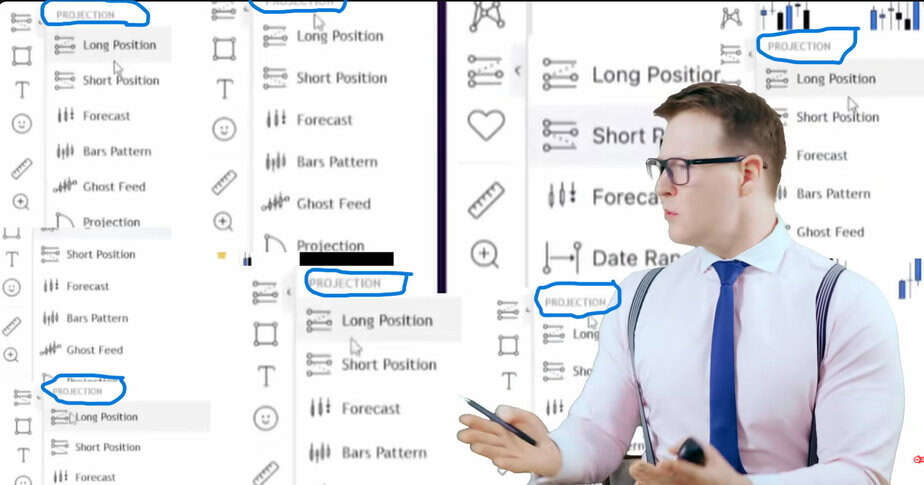
This matters because TradingView Projection is a visualization feature for charting. It draws a colored rectangle on the chart showing what a hypothetical position's profit and loss would look like at different price levels. It does not place an order. It does not commit capital. It does not interact with any broker. It is, by design, a paper-trading sketch tool.
Compare this to legitimate live trading, which would show:
- A real broker interface (e.g., NinjaTrader, TradeStation, Interactive Brokers' DOM, or similar)
- Actual fill prices on actual orders
- Open positions visible in an account window with real P&L
- A verifiable broker statement at the end of the period
None of these appear in TJR's content. What appears, repeatedly, is the TradingView Projection menu — captured cleanly in multiple frames of his own videos.
In my opinion, using a charting projection tool while telling viewers you are "live day trading" is fundamentally dishonest. It creates the impression of executed trades when no trades are being executed. It allows the creator to construct any outcome they want after the fact. And it permits an entire content business to be built on the appearance of trading skill without any actual trading skill being demonstrated.
4) His Strategy Is Just Rebranded ICT (Inner Circle Trader)
TJR's "strategy" relies on terms that observant viewers will immediately recognize: fair value gaps, liquidity sweeps, order blocks, break of structure, smart money concepts (SMC). These are not Tyler's concepts. They are the Inner Circle Trader (ICT) framework popularized by Michael J. Huddleston.
Side-by-side comparison of TJR's tutorial language against ICT's source material shows the framework is essentially identical: same definitions, same setups, same workflow. TJR has added his own personal branding to the concepts, but the underlying methodology is a verbatim rebrand.
In my opinion, this matters for two reasons:
First, the ICT framework itself has been heavily criticized in the professional trading community. Critics argue it amounts to rebranded support/resistance with no statistical edge, that the originator has been unable to publish verified profitable trading statements over multiple-year periods, and that the framework's complexity primarily serves to make the concepts feel proprietary when they are not.
Second, TJR is charging $4,000 to teach a framework that is freely available, in much greater depth, from the original source. There is no value-add here. He has not improved the methodology, validated it with verified results, or added a single new concept. He has simply put his face on it.
See the Strategy Live Real-time options alerts from a verified Wall Street trader with verified multi-year E*TRADE returns. 14-day trial available.
Follow My Trades with Real-Time Trade Alerts
5) The Academic Data Shows Day Trading Is Statistically Gambling
This reason is the most important for prospective students to internalize, because it is not about Tyler — it is about the activity itself.
The Sao Paulo School of Economics study. A comprehensive 2020 academic study titled "Day Trading for a Living?" analyzed nearly 20,000 individuals who began day trading in the Brazilian equity index futures market between 2013 and 2015 and persisted for at least 300 trading days. The findings:
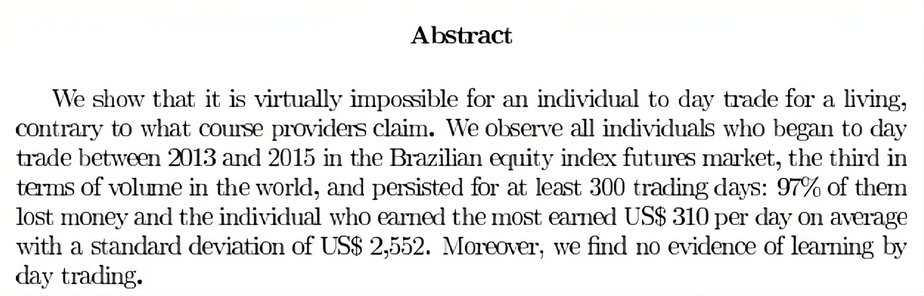
"We show that it is virtually impossible for an individual to day trade for a living, contrary to what course providers claim. We observe all individuals who began to day trade between 2013 and 2015... 97% of them lost money, and the individual who earned the most earned US$ 310 per day on average with a standard deviation of US$ 2,552. Moreover, we find no evidence of learning by day trading."
Three observations worth highlighting:
- 97% lost money — not "most beginners struggle," but the overwhelming statistical reality
- The single best trader in the study averaged $310 per day with massive variance — meaningfully less than what TJR claims to make personally, and earned by the absolute top performer out of ~20,000 people
- No evidence of learning — performance does not improve with experience. Practicing day trading does not make you a better day trader. This directly contradicts every "mindset" and "reprogram your mind" pitch
The Taiwan study. A separate large-scale academic analysis by Barber, Lee, Liu, and Odean titled "Do Day Traders Rationally Learn About Their Ability?" analyzed heavily active traders in Taiwan over a 15-year period. The conclusion: less than 1% of day traders are predictably profitable after fees.
The regulatory consensus. The SEC has issued explicit investor warnings stating that day traders "typically suffer severe financial losses in their first months of trading." The FTC warns consumers to be skeptical of promoters claiming "low risk" and "high returns" in speculative markets.
In my opinion, this is the part most TJR students don't understand: the math of day trading is against you regardless of mindset, regardless of education, and regardless of how much you pay for a course. When someone tells you that 97% of day traders lose money because they need to "reprogram their mind," they are misrepresenting both the data and the cause.
6) 1of1 Funding: The 100% Payout Promise Has Serious Red Flags
TJR is heavily affiliated with 1of1 Funding, a proprietary trading firm he co-founded. The firm advertises a 100% profit split to traders — an industry-leading payout that, on its surface, sounds incredible.
From a basic business perspective, this raises an immediate question: if the firm pays out 100% of trading profits to traders, where does the firm's revenue come from?
The most likely answer, per industry watchdogs and reviewers: evaluation fees paid by traders who fail to pass the firm's challenges. This is the dominant revenue model for the entire prop firm industry, and it creates a structural conflict of interest:
- The firm benefits when traders fail evaluations (collecting the fees)
- The firm bears cost when traders succeed (paying out trader profits with no revenue offset)
- Therefore, the firm's incentives are misaligned with trader success
The independent prop firm review site FirmFunded.com has flagged exactly this concern, noting: "Since the firm does not generate revenues from proprietary trading, it must be collecting funded account fees which motivates it to have a high fail rate. This raises a conflict of interest between the firm and its clients, and it always ends badly for traders."
FirmFunded.com went further, flagging 1of1 Funding with an explicit "Scam alert! 100% payout claims!" warning.
Customer complaints reinforce this concern. Better Business Bureau filings from 1of1 Funding customers allege that winning traders have been denied payouts. A typical complaint: "So they take your money and hope that you don't have any winning trades. But when you have a winning trade, you never get paid out."
On Trustpilot, 1of1 Funding's overall rating has slipped to a middling ~3.4/5 — and reviewers have raised concerns that even that figure is inflated. Multiple observers note that 5-star reviews appear in suspicious same-day clusters, that many reviewers have only ever posted one review (their 1of1 Funding review), and that the language patterns suggest AI-generated content. The negative reviews are detailed and specific; the positive ones are generic.

In my opinion, a prop firm whose business model depends on traders failing is a structural conflict that no marketing can fix. Regardless of marketing copy, the firm's profitability and the trader's profitability are fundamentally opposed.
7) He Has Never Published Verified Broker Statements
For anyone selling a $4,000 trading course, the most basic credibility credential is a verified, multi-year, deposit-adjusted broker statement from a regulated brokerage.
Verified means: real account, real broker, real statement, with deposits and withdrawals visible so account-value changes can be attributed to either trading P&L or capital flows.
Deposit-adjusted matters because account value can grow from deposits as easily as it can grow from trading. Showing a chart of "account value going up" without disclosing deposits is meaningless. Many guru-style traders have been documented inflating their account value by transferring in capital from course revenue and presenting the resulting balance growth as if it were trading profit.
TJR has never published this. No regulated U.S. broker statement. No multi-year audited P&L. No deposit-adjusted equity curve. The "proof" his content offers consists of:
- TradingView screenshots (charting software, not broker software)
- Projection-tool annotations (not executed trades)
- Cherry-picked winning trades with no record of the losers
- Lifestyle imagery (cars, houses, watches — none of which is evidence of trading skill)
In my opinion, the absence of a verified broker statement is the single most important credential gap in any trading-education business. It is the one thing a real profitable trader can produce trivially, and the one thing a course-seller will never produce because it would undermine the business model.
For comparison, my own multi-year E*TRADE statements — including underperforming years — are published openly at my verified results page. Verified statements are not optional; they are the floor.
8) The "Reprogram Your Mind" Pitch Is Predatory Pseudo-Science
In multiple high-view videos, TJR promotes a recurring message: students lose because they haven't "reprogrammed their minds" or "manifested" success. The strategy is fine, the argument goes — the problem is the student's psychology, mindset, and belief system.
In my opinion, this framing is one of the most predatory rhetorical patterns in the guru ecosystem, for three reasons:
First, it relocates blame from the strategy to the student. When students lose money following TJR's instructions, the message they receive is: "It's your fault. You weren't disciplined enough. You haven't reprogrammed your mind." This shields the strategy from accountability and keeps students paying for more "mindset" content rather than questioning whether the strategy works.
Second, it contradicts the academic data. The Sao Paulo study explicitly found no evidence of learning by day trading. Performance does not improve with effort, time in market, or psychological reprogramming. The "mindset is everything" narrative is a marketing tool, not a statistical truth.
Third, it shifts focus to recurring purchases. Students who fail are encouraged not to leave but to double down — buy more coaching, attend more psychology calls, join more Discord tiers. The business model rewards keeping losing students in the funnel, not graduating them to consistent profitability. In my video critique of TJR's content, I noted exactly this pattern: rather than questioning whether day trading is sustainable for retail at all, the pitch is always "join my community, fund my lifestyle, and I'll be your therapist."
In my opinion, this is how losing traders get exploited. The statistical reality — that day trading is structurally negative-expectancy for retail — is reframed as a personal failing the guru can solve, if only the student pays for one more month.
Ready to See Verified Trades and Disciplined Risk Management? Join 127+ five-star reviewers already following the Financed Bull Strategy.
Take the Complete Options Trading Course
- Learn the full system so you can trade independently
- Master the complete step-by-step framework
- Understand the “why” behind every trade
- Understand the “why” behind every trade
TJR Trades Net Worth: The Real Business Model
If 97% of day traders lose money and Tyler has never shown a verified broker statement, how does he afford the cars, the Miami house, and the lifestyle marketing?
The answer, in my opinion: he is a highly successful marketer, not a successful trader.
Based on his ~1 million YouTube subscribers, his publicly disclosed product offerings, and standard industry conversion rates, here is a realistic estimate of his annual revenue:
Estimated annual revenue streams (per independent analysis)
Revenue source | Low estimate | High estimate |
|---|---|---|
Courses ($4,000 each, 0.05%–0.5% conversion of 1M subs) | ~$2,000,000 | ~$20,000,000 |
Affiliate marketing (broker links, prop firms, etc.) | ~$60,000 | ~$600,000 |
Indicator/tool bundles ($60/month × subscribers) | ~$360,000 | ~$3,600,000 |
Broker sponsorship (estimated monthly retainer) | ~$120,000 | ~$1,200,000 |
1of1 Funding prop firm affiliation (signups + revenue share) | ~$300,000 | ~$800,000 |
YouTube ad revenue ($10–$20 RPM × ~280K daily views) | ~$1,000,000 | ~$2,000,000 |
Subtotal (selling products) | ~$1.6M | ~$15.4M |
Adjusted for a realistic cross-buy rate (the same person doesn't buy every product), conservative estimates land at roughly $2.4 million per year. Aggressive estimates run higher than $15 million per year. Either way, the conclusion is the same: Tyler is a multimillionaire from selling courses and affiliate products to aspiring traders — not from beating the S&P 500.
This is the defining characteristic of the modern fake-guru business model: the money is made by selling the dream to others, not by doing the thing the dream is supposedly built on. Across crypto promotion, course sales, indicator bundles, prop firm affiliation, and YouTube ad revenue, Tyler has built a multi-million-dollar marketing business that does not require him to be a profitable trader at all.
I estimate Tyler Riches's net worth in the $15–$25 million range, with the overwhelming majority coming from product sales rather than trading P&L.
Another guru whose net worth primarily comes from selling courses and memberships, not investing, is Kiana Danial from Invest Diva.
So is Shay Huang of Humbled Trader, another day-trading educator I recently reviewed.
A Better Way: The "Financed Bull" Strategy
If you want to build wealth in markets, the data is clear: day trading is statistically a losing game. The disciplined alternative is selling option premium on large-cap quality stocks while hedging tail risk — a strategy with mathematically positive expected value, a verifiable track record, and none of the structural problems of TJR's approach.
Here's how my approach differs:
Factor | TJR Trades | BestStockStrategy (David Jaffee) |
|---|---|---|
Verified track record | No published broker statements | Real E*TRADE statements at /results/, including underperforming years |
Pricing transparency | Hidden behind funnel; reported ~$4,000 course | $279 14-day trial, $1,250 three-month plan — published openly |
Strategy | Day trading futures with ICT/SMC concepts | "Financed Bull" — selling option premium with debit-spread hedging on large-cap quality stocks |
Activity level | High-frequency intraday trading | ~10 minutes per day; positions held days to weeks |
Statistical evidence | 97% of day traders lose money (Sao Paulo study) | Options selling has well-documented positive expected value |
Risk management | Concentrated futures positions, prop firm leverage | Defined-risk spreads, hedging, position sizing |
Background | Crypto YOLO; family wealth; courses | Ivy League graduate, former Wall Street investment banker |
The Financed Bull strategy is the opposite of day trading. Instead of trying to predict short-term price direction (which the academic data shows is essentially gambling), it sells time decay on large-cap quality companies — names like NVDA, GOOGL, AMZN, MSFT, and SMH. Combined with hedging during low-volatility periods, this approach produced verified returns of approximately +78% and +67% in my two E*TRADE accounts over the past 12 months. Full details, including the years I underperformed, are at my verified results page.
Conclusion: My TJR Trades Review
In my opinion, TJR Trades is not a legitimate trading education business — it is a course-selling business built around the appearance of trading.
The pattern is clear and documented: a "rags-to-riches" origin story contradicted by family wealth records; initial wealth from a leveraged crypto YOLO presented as evidence of trading skill; "live trades" that appear to use a charting projection tool rather than real broker orders; a rebranded ICT methodology with no statistical edge; an affiliated prop firm with a structurally conflicted business model; no verified broker statements; and a "reprogram your mind" pitch that systematically blames students for losses while keeping them in the funnel.
The academic data is unambiguous. 97% of day traders lose money. There is no evidence that performance improves with experience. When an influencer with no verified track record tells you that you can make $5,000 per day if you just buy his course and "reprogram your mind," he is selling you a statistical impossibility. The mathematics of the activity do not change based on mindset, discipline, or money spent on courses.
In my opinion, you should not buy TJR's course, and you should not fund 1of1 Funding. If you believe you have been misled, the resources below can help.
Alternatives to TJR (2026)
If you're looking for alternatives to TJR Trades and 1of1 Funding, here's what I'd recommend instead.
1. Skip the funded-account treadmill. Prop-firm challenges make money on evaluation fees whether you succeed or not. Trading your own capital with a hedged premium-selling strategy — selling option premium with debit-spread hedging (Financed Bull) — removes that conflict entirely. My trailing-twelve-month results, +78% and +67%, are verified here.
2. Free education beats paid hype. My free training teaches the core of a strategy you can actually verify — no Discord, no challenge fees.
3. Vet every guru the same way. Verified results or brokerage statements, or you walk — it's a one-question filter that eliminates most of this industry.
Looking for a Legitimate Options Trading Education?
If you're researching trading educators because you've been burned (or want to avoid being burned), here's what actually works.
I'm a former Wall Street investment banker — interned at Morgan Stanley, then worked at CIBC World Markets and Petsky Prunier. I generate verified +78% and +67% returns on real E*TRADE accounts, fully documented at my verified results page.
The strategy that actually works isn't day trading penny stocks, buying expensive courses from people without verified records, or following unverified trading "gurus." It's selling option premium with debit-spread hedging (the "Financed Bull" strategy) for consistent monthly income on high-quality stocks.
Read my guide to Selling Options Premium for Consistent Income — or join the 127+ five-star reviewers who follow my real-time trade alerts.
Consumer Resources & Protection
If you believe you have been the victim of deceptive marketing, fraud, or financial misconduct, the following federal, state, and self-regulatory resources can help:
- Federal Trade Commission (FTC) — report fraud and deceptive business practices: reportfraud.ftc.gov
- U.S. Securities and Exchange Commission (SEC) — submit a tip or complaint about investment fraud or unregistered investment advice: sec.gov/submit-tip-or-complaint
- Commodity Futures Trading Commission (CFTC) — for complaints involving futures, prop trading firms, and commodity-related fraud: cftc.gov/complaint
- FINRA — file a complaint regarding broker conduct or unregistered investment activity: https://investor-complaints.datacollection.finra.org/
- FBI Internet Crime Complaint Center (IC3) — for internet-based fraud: ic3.gov
- Your State Attorney General — find your state's consumer protection office: naag.org/find-my-ag
- Better Business Bureau (BBB) — file a complaint against a business: bbb.org/file-a-complaint
- Consumer Financial Protection Bureau (CFPB) — for financial product and service complaints: consumerfinance.gov/complaint
Get the Complete Framework — Free Get $400+ of free options trading training and the Trader's Edge cheat sheet. Join 127+ five-star reviewers. No credit card required.
Frequently Asked Questions
Who is TJR Trades?
TJR Trades is the online persona of Tyler Riches, a day-trading influencer in his early twenties who also operates under the name "Top Floor Boss." He is based in California, has approximately 1 million YouTube subscribers, sells a paid course for around $4,000, and co-founded a proprietary trading firm called 1of1 Funding. He markets himself as a self-made millionaire who built his wealth from day trading.
What is TJR Trades' net worth?
I estimate Tyler Riches's net worth in the $15–$25 million range, with the overwhelming majority coming from selling courses, affiliate marketing, indicator bundles, broker sponsorship, prop firm fees, and YouTube ad revenue — not from day trading profits. Combined annual revenue estimates from independent analysis range from roughly $1.6 million to over $15 million per year.
Is TJR Trades a scam?
I cannot make that determination for you legally. What I can say based on documented evidence: his rags-to-riches origin story is contradicted by public tax filings showing significant family wealth; his initial fortune came from a leveraged crypto bet, not trading; his "live trades" appear to use TradingView's Projection tool rather than real broker orders; his strategy is rebranded ICT; and he has never published a verified broker statement. In my opinion, this is not a business model retail traders should trust with their money. To be clear, there is no regulatory action against TJR — unlike Warrior Trading, which the FTC fined over $3 million for deceptive earnings claims.
Did Tyler Riches really go from broke to millionaire by day trading?
In my opinion, no. Public records suggest his family has significant wealth — his father reportedly earns over $500,000 per year as President of Pinewood School. By Tyler's own admission on a podcast, his initial millions came from a $100,000 high-interest loan placed on Solana cryptocurrency in 2021, not from day trading. The "broke DoorDash driver" narrative appears to be marketing rather than fact.
What is 1of1 Funding and is it legit?
1of1 Funding is a proprietary trading firm co-founded by Tyler Riches that advertises a 100% profit split to traders. In my opinion, the 100% payout model creates a serious structural conflict: since the firm cannot generate revenue from trading profits, its revenue depends on evaluation fees paid by traders who fail. The Better Business Bureau lists complaints from customers alleging that winning traders are not paid out, and independent reviewers have flagged Trustpilot review patterns that appear suspicious.
Does TJR Trades actually trade live with real money?
In my opinion, the public evidence does not support this claim. Multiple investigators have documented that TJR's "live day trading" videos appear to show him using TradingView's Projection tool — a chart visualization feature — rather than actually executing trades through a broker. He has never published a verified broker statement from a regulated U.S. broker showing his trading performance over a meaningful period of time.
Is ICT (Inner Circle Trader) strategy legit?
In my opinion, no. The ICT framework — fair value gaps, liquidity sweeps, order blocks, smart money concepts — has been heavily criticized in the professional trading community for amounting to rebranded support/resistance with no statistical edge. The originator has reportedly been unable to publish verified profitable broker statements. Critics argue that the framework's complexity makes the concepts feel proprietary even though they have no demonstrated predictive value.
Why do academic studies say day trading doesn't work?
Large-scale academic studies — the Sao Paulo School of Economics analysis of ~20,000 Brazilian day traders and the Barber/Lee/Liu/Odean analysis of Taiwanese day traders — consistently find that the vast majority of day traders lose money (97% in the Brazilian study), the best traders earn relatively modest amounts with massive variance, and performance does not improve with experience. The activity has negative expected value for retail traders due to fees, bid-ask spreads, and the difficulty of competing with institutional algorithms.
Should I buy TJR's course or join 1of1 Funding?
In my opinion, no. The strategy he teaches (rebranded ICT) is available for free; his "live trades" appear to be projection-tool annotations rather than real trades; his initial wealth came from a crypto YOLO rather than trading; and the 1of1 Funding business model has a structural conflict of interest that historically ends badly for traders. There is no edge here worth paying $4,000 for.
How is BestStockStrategy different from TJR Trades?
I publish my real E*TRADE brokerage statements — including the years I underperformed — at my verified results page. My pricing is public ($279 for a 14-day trial). I teach selling option premium on large-cap quality stocks rather than day trading speculative futures. I have 127+ five-star Trustindex reviews. And the strategy I teach has well-documented positive expected value, unlike day trading, which the academic data shows is statistically negative for retail participants.
What should I do if I lost money following TJR Trades' advice?
If you believe you have been the victim of deceptive marketing or financial misconduct, the Consumer Resources section above lists the federal, state, and self-regulatory agencies you can file complaints with — including the FTC, SEC, CFTC, FINRA, IC3 (FBI), your State Attorney General, BBB, and CFPB. If your losses are substantial, you may also want to consult with a securities attorney to discuss whether you have grounds for a private complaint.
What is TJR's real name?
TJR's real name is Tyler J. Riches. He operates under the brands TJR Trades and "Top Floor Boss," and his company, TJR LLC, is reportedly based in Miami, Florida. Note that he should not be confused with "TJR" the DJ and music producer — that is an entirely different, unrelated person, despite the shared initials frequently confusing search results.
How old is TJR?
Third-party profiles report that Tyler Riches was born on April 6, 2002, which would make him 24 as of mid-2026. Treat this as reported rather than independently verified — he has not published verified biographical records, and most coverage simply describes him as a trading influencer in his early twenties.
Disclaimer
This article reflects my personal opinion and analysis, along with publicly available tax records, the documented public statements of the subject, and the publicly published investigations of independent third parties. Statements regarding TJR Trades' trading practices, strategy quality, and net worth are my opinion based on publicly available videos and information. The IRS Form 990 filings referenced are matters of public record and accessible via ProPublica's Nonprofit Explorer. Nothing in this article is investment advice, legal advice, or a recommendation to buy or sell any security. I am not a registered investment advisor. Day trading involves substantial risk of loss; academic research suggests the overwhelming majority of retail day traders lose money. Always do your own research and consult a qualified professional before making financial decisions.